
COERCED FAITH ON THE HIGHWAY: HOW THE WEAPONIZATION OF RELIGIOUS SLOGANS IS FUELING VIGILANTE VIOLENCE IN UTTAR PRADESH, INDIA

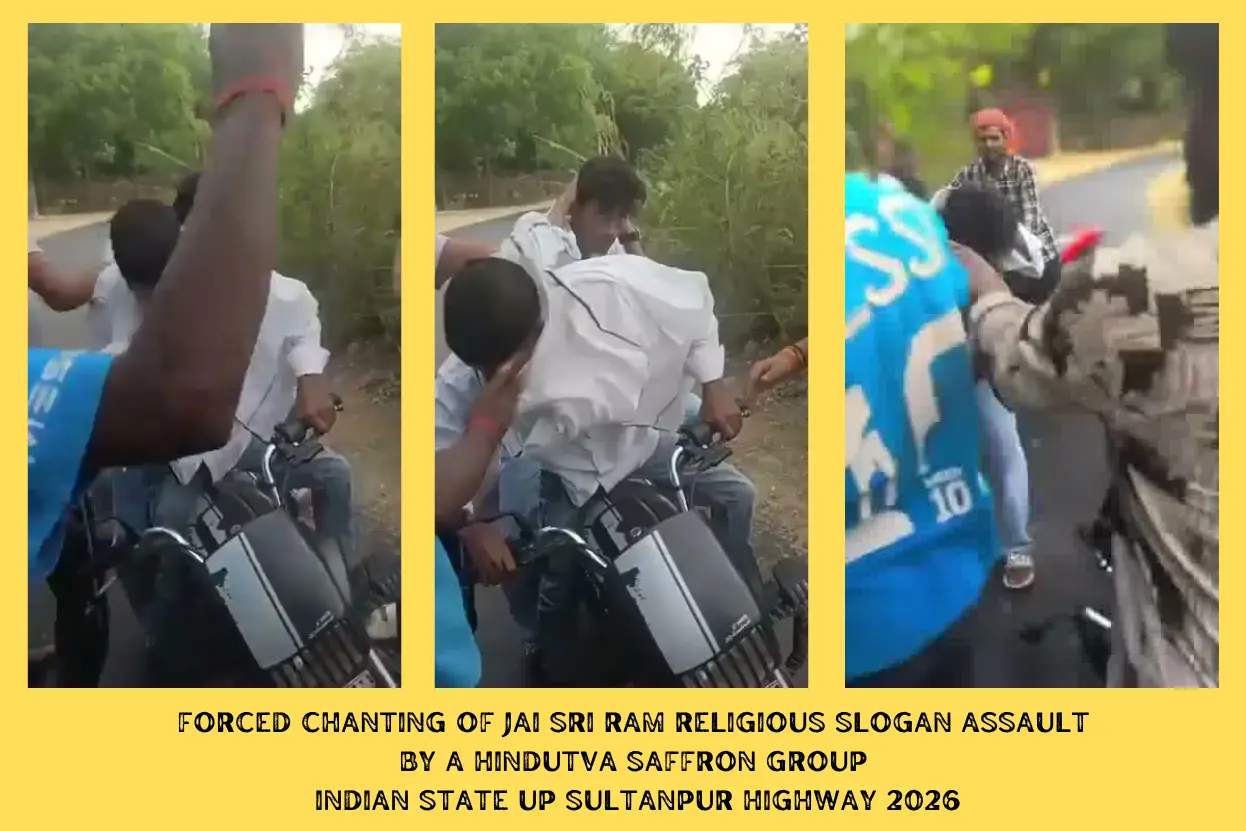
The brutal assault of two Muslim men in Sultanpur underscores a deeply unsettling nationwide trend of minoritarian intimidation, grassroots radicalization, and the political distortion of sacred cultural symbols.
Video Footage
The Anatomy of an Assault: What the Sultanpur Footage Reveals
A deeply disturbing mobile video capturing the brazen assault of two young Muslim men on a rural highway in the Sultanpur district of Uttar Pradesh has once again ignited a fierce national debate surrounding minority safety, hate crimes, and the normalization of vigilante justice. The footage, which rapidly went viral across various social media networks, offers a harrowing, unedited glimpse into the mechanics of targeted communal intimidation that has increasingly plagued India’s most populous state.
The video begins mid-incident on an isolated stretch of a bitumen road flanked by dense shrubbery. Two Muslim men, traveling peacefully on a commuter motorcycle, are abruptly intercepted and cornered by a group of aggressive youths, many of whom are seen wearing markers of right-wing political affiliation. What follows is not a spontaneous altercation, but a systematic exercise in humiliation and physical violence.
The assailants quickly surround the vehicle, physically pulling the riders off the bike. As the victims attempt to reason with the crowd, they are met with a barrage of verbal abuses, slaps, and heavy blows. The motorcycle is deliberately overturned onto the asphalt—a symbolic act of stripping the victims of their mobility and means of escape.
The crux of the confrontation, however, is not material dispute or traffic friction; it is ideologically driven coercion. The mob is seen repeatedly striking the victims, demanding that they chant “Jai Shri Ram” (Victory to Lord Ram). The victims, visibly terrified and breathing heavily, attempt to shield their faces from the rain of blows while their religious identity is explicitly targeted. The video concludes with the victims being pushed into the dirt, their dignity violated, as the perpetrators record the entire sequence on their smartphones—treating an act of brutal communal assault as a trophy for digital consumption.
The Coercion of Faith: The Political Distortion of ‘Jai Shri Ram’
To understand why a phrase deeply rooted in Hindu theology has transformed into a trigger for highway violence, one must analyze the socio-political shift in modern India. Historically, “Jai Shri Ram” or “Ram-Ram” functioned as a benign, peaceful religious greeting across the Hindi-speaking heartland, signifying devotion, righteousness, and mutual respect.
However, over the last few decades, fringe radical elements and right-wing vigilante groups have strategically weaponized this sacred chant. It has been systematically detached from its original spiritual context and refashioned into a cultural and political battering ram.
“The forced chanting of religious slogans is not an act of piety; it is an assertion of majoritarian dominance. It is designed to remind the minority population of their subordinate status in the public square. When a sacred name is used to break a person’s spirit, it ceases to be a prayer and becomes an instrument of terror.” — Siddharth Varadarajan, Veteran Journalist and Civil Liberties Advocate.
The core psychological objective of these mobs is not to convert the victim or to invoke genuine religious devotion. Instead, forcing a Muslim to utter a phrase that directly conflicts with their strict monotheistic Islamic faith is the ultimate expression of humiliation. For the perpetrators, a successful coerced chant represents a total capitulation of the minority identity under the threat of physical annihilation.
A Chronic Trend: Mapping Vigilante Violence Across the State
The incident in Sultanpur is far from an isolated anomaly. Over the past several years, Uttar Pradesh has emerged as a volatile epicenter for similar highway interventions, cow-protection lynchings, and forced religious sloganeering. From industrial hubs like Kanpur to rural pockets like Unnao and Bulandshahr, a terrifyingly consistent pattern has emerged.
| Date/Period | Location (UP) | Nature of the Incident | Official State/Police Response |
| July 2019 | Unnao | Madrasa students beaten with cricket bats; forced to chant religious slogans. | FIR registered under pressure; minor scuffle angle initially pushed. |
| August 2021 | Kanpur | E-rickshaw driver paraded, assaulted in front of his weeping young daughter. | Multiple arrests made only after national media outcry and viral video evidence. |
| June 2023 | Bulandshahr | Muslim youth tied to a tree, head shaved, forced to chant slogans over alleged theft. | Arrests made; localized crime narrative emphasized over communal targeting. |
| Mid-2026 | Sultanpur | Two motorists intercepted on the highway, assaulted, and bike vandalized. | Investigation underway; public pressure mounting for stringent National Security Act (NSA) charges. |
This structural breakdown illustrates that the highway has become a highly contested space for minorities. What should be a public utility for safe transit has, in many semi-urban and rural sectors, devolved into a gauntlet where identity determines physical safety.
Institutional Failures: The Culture of Deniability and Impunity
A critical factor enabling the persistence of these hate crimes is the nature of the institutional response. When videos of such nature surface, the immediate reaction of local law enforcement often follows a predictable playbook of minimization.
- The Narrative of ‘Simple Scuffles’: Police departments frequently issue preliminary statements characterizing these targeted assaults as “petty arguments over right-of-way,” “road rage,” or “localized disputes,” deliberately stripping the incident of its overt communal and theological motives.
- Delayed FIR Registration: Victims of communal vigilante violence face immense systemic hurdles when attempting to file a First Information Report (FIR). Due to political pressure from local majoritarian outfits, police stations often hesitate to apply stringent anti-hate crime sections of the Indian Penal Code.
- The Threat of Counter-Cases: In many instances, the perpetrators or their political backers file counter-complaints alleging reckless driving, theft, or insult to religious feelings against the victims, effectively trapping the traumatized individuals in a exhausting legal quagmire.
This environment of institutional deniability fosters a dangerous culture of impunity. When young men realize that filming an assault and uploading it online yields social media clout within radical circles with minimal legal consequences, the incentive to repeat these crimes increases exponentially.
The Judicial Framework: Constitutional Guarantees vs. Ground Realities
The ongoing crisis of vigilante violence stands in direct violation of the foundational tenets of the Constitution of India. Article 21 guarantees the right to life and personal liberty, which includes the right to live with human dignity and freedom from arbitrary violence. Furthermore, Article 25 ensures freedom of conscience and the free profession, practice, and propagation of religion.
The Supreme Court of India has previously taken a stern view of this growing lawlessness. In the landmark Tehseen S. Poonawalla v. Union of India (2018) case, the apex court issued comprehensive guidelines to combat lynching and mob violence, declaring that:
“Horrendous acts of mobocracy cannot be allowed to become the new normal… The state has a sacrosanct duty to ensure that the secular fabric of society is sustained, and no citizen is forced to live in a state of constant fear due to their identity.”
The Supreme Court mandated the appointment of a nodal police officer in each district to prevent mob violence, the fast-tracking of trials, and exemplary punishment for perpetrators. However, as the Sultanpur video demonstrates, there remains a massive, tragic chasm between the progressive jurisprudence of New Delhi and the grim, unchecked reality of the rural highways of Uttar Pradesh.
The Socio-Psychological Toll on the Fabric of India
Beyond the immediate physical injuries inflicted upon the victims, the wider societal impact of these forced-chanting videos is devastating. They function as a highly effective form of psychological warfare against the broader minority community.
When a Muslim citizen watches a fellow community member being beaten on a public road with absolute impunity, it induces a state of chronic anxiety and hyper-vigilance. Everyday activities—commuting to work, transporting goods across state lines, or simply traveling with family—become fraught with existential dread.
Concurrently, it severely damages India’s global standing as a pluralistic democracy. As an ancient civilization built on the ideals of Vasudhaiva Kutumbakam (The World is One Family) and a modern state bound by secular laws, the continuous stream of majoritarian street violence tarnishes the nation’s democratic credentials on the international stage.
Restoring the Rule of Law
The Sultanpur highway assault is a mirror reflecting a dangerous societal ailment. If India is to preserve its constitutional soul, the response to such incidents must transcend routine political statements and standard bureaucratic investigations.
True deterrence can only be achieved when the state machinery treats these acts not as isolated altercations, but as deliberate acts of domestic terror designed to fracture communal harmony. The perpetrators in the Sultanpur video must be prosecuted under the full weight of the law, setting a non-negotiable precedent that the public roads of India belong equally to all citizens, regardless of how they choose to pray. Until the state demonstrates the political will to decisively dismantle the infrastructure of hate, the highway will remain a perilous frontier for the vulnerable.