How to Avoid Being Banned by Google: Preventing Traffic Drops and Recovering Rankings
ByShahriar HossainPublished onUpdated on
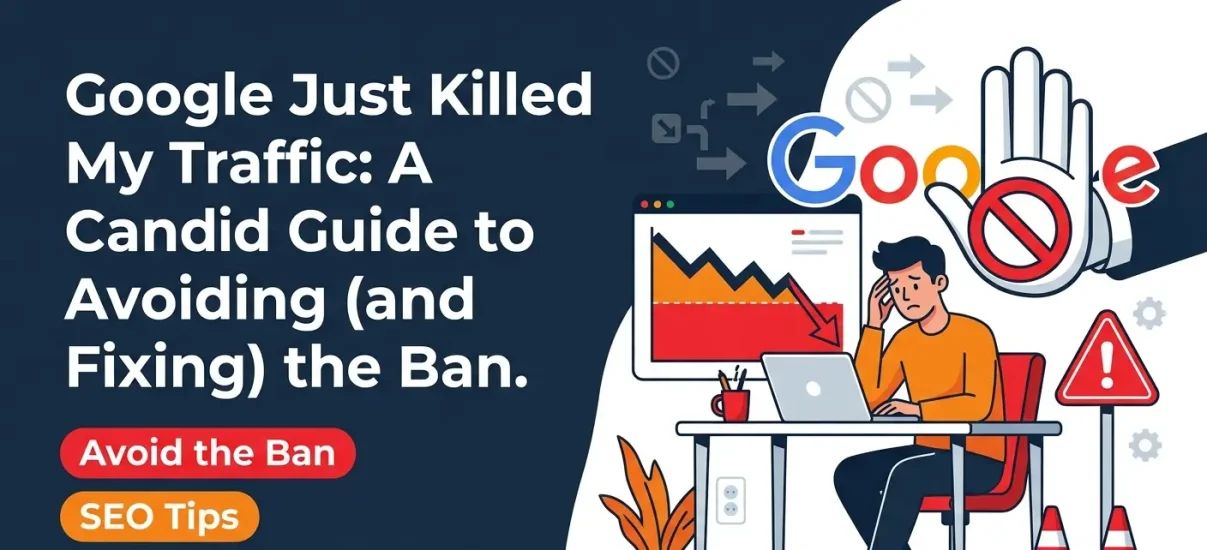
There is a specific kind of nausea that hits you when you open your analytics in the morning. You’re sipping coffee, expecting the usual numbers, and then you see it. The cliff. The red line pointing straight down.
Impressions are gone. Keywords have vanished. The revenue tap? Turned off.
The first thought is always panic:“Did I get banned? Is my site dead?”
I’ve been there, and I’ve helped plenty of site owners who were standing on that same ledge. Here is the reality: Google is ruthless about quality, and in 2024, they went on a warpath. Whether it’s a full-blown account ban or the silent, agonizing “shadow ban,” the result feels the same. You’re invisible.
But you aren’t helpless. Let’s walk through what is actually happening, how to figure out if you’re in penalty purgatory, and how to claw your way back.
The “Nuclear Option”: Permanent Bans
First, let’s clear up a misconception. Most people think they are “banned” when they are just ranking poorly. A permanent ban is rare and it is terrifying.
This is the nuclear option. It’s not just your site; it’s your digital identity. You lose access to Gmail, Drive, YouTube, and AdSense. You try to log in, and Google simply says “No.”
This usually only happens if you have been doing something truly sketchy—severe fraud, massive malware distribution, or repeatedly violating terms after being warned. If this happens, Google usually sends an email to your recovery address.
If you can still log into your email, breathe. You aren’t banned from Google. You’re just in SEO jail.
The Silent Killer: Shadow Bans & Algo Updates
This is what happens to 99% of people. You didn’t get an email. You didn’t get a notification. You just got… ghosted.
In the SEO world, we often call this a “shadow ban,” though Google hates that term. They call it “algorithmic devaluation.”
It feels like a gas leak.
Sometimes it’s a sudden drop overnight (usually coincident with a Core Update).
Sometimes it’s a slow, painful bleed where you lose 5% of your traffic every week until there’s nothing left.
This happens because the algorithm—the mathematical brain of Google—looked at your site and decided, “You know what? This isn’t the best answer anymore.” Maybe it thinks your content is thin. Maybe it thinks you’re spamming keywords. Maybe it just found a Reddit thread it likes better.
Step 1: Stop Guessing, Look at the Data
Before you start deleting pages or firing writers, you need to play detective. You need Google Search Console (GSC).
If you don’t have GSC set up, stop reading this and go do it. It’s the only way Google talks to us.
Once you are in-
Check “Manual Actions”: Look at the menu on the left. If you see a red flag here, a human at Google actually reviewed your site and pushed the “penalty” button. This sounds bad, but it’s actually good news. It means if you fix the specific thing they list (like “Unnatural Links”), you can ask them to look again.
Check “Security Issues”: Make sure you haven’t been hacked.
The “Algo” Check: If those two sections are clean, but your traffic is zero, you’ve been hit by an algorithm update.
Check the dates. Did your traffic nose-dive on March 5th or August 15th? Google runs massive “Core Updates” and “Spam Updates” a few times a year. If your drop lines up with those dates, you were collateral damage in Google’s war on low quality.
The Elephant in the Room: AI Content
Let’s be real for a second. Since ChatGPT came out, everybody became a “publisher.”
People started generating thousands of articles with prompts like “Write me 50 articles about dog food.” They copied, pasted, and waited for the cash to roll in.
Google isn’t stupid. They saw this coming a mile away.
You don’t get banned for using AI. You get banned for publishing lazy content.
If your strategy was “Generate -> Copy -> Paste,” your site is likely toxic in Google’s eyes. The algorithm looks for “Helpful Content.” An AI hallucinating facts or repeating the same three sentences isn’t helpful. It’s clutter.
The Fix: If you use AI, treat it like an intern. It can do the research, it can build the outline. But a human—someone with actual experience (EEAT)—needs to rewrite it, fact-check it, and add that personal touch that a robot can’t fake.
How to actually recover (The Hard Truth)
I wish I could tell you there is a “fix it” button. There isn’t. Recovery is a grind.
If it’s a Technical Issue-
Did you change hosting? Mess up your SSL certificate? Block Googlebot in your robots.txt file? These are easy fixes. Undo the change, validate it in Search Console, and you’ll bounce back in a couple of weeks.
If it’s a Quality/Content Issue-
This is the long game. You need to audit your site.
Kill the Zombies: Look at pages getting zero traffic. Delete them, or merge them into one great guide.
Show Your Face: Google wants to know who is writing. Add author bios. Link to your LinkedIn. Show that you are a real expert, not a content farm.
Wait: If you were hit by a Core Update, you often won’t see a full recovery until the next Core Update rolls out. That can take months. It sucks, but it’s the reality.
How to Sleep at Night (Future-Proofing)
The only way to avoid this stress in the future is to stop relying solely on Google.
If 100% of your customers come from search, you don’t have a business; you have a dependency. Build an email list. Get active on social. Diversify.
And please, just write for humans. It sounds cliché, but it’s the only strategy that has survived twenty years of algorithm updates. If you solve the user’s problem quickly and honestly, the rankings usually take care of themselves.
Here is your immediate next step-
Open Google Search Console right now. Go to the Performance tab and compare the last 28 days to the previous period. Identify exactly which pages lost the most traffic. That is your crime scene—start your investigation there.