Passive Income Reality: Myths, Origins, and How to Build Real Cash-Generating Assets
ByShahriar HossainPublished onUpdated on
“Passive income.” It’s become one of the most buzzed-about phrases online, right up there with “crypto” and “side hustle.” Who hasn’t dreamed of money flowing into their bank account while they’re sleeping, backpacking across Asia, or just chilling on the couch?
But let’s get real. What is passive income, actually?
This guide cuts through the noise. We’re going to explore the often-harsh reality of passive income, smash the biggest myths, and reveal the true path to financial freedom: building genuine cash-generating assets. If you’re tired of the online hype, you’ve come to the right place. Understanding this starts with ditching the fantasy and embracing the facts.
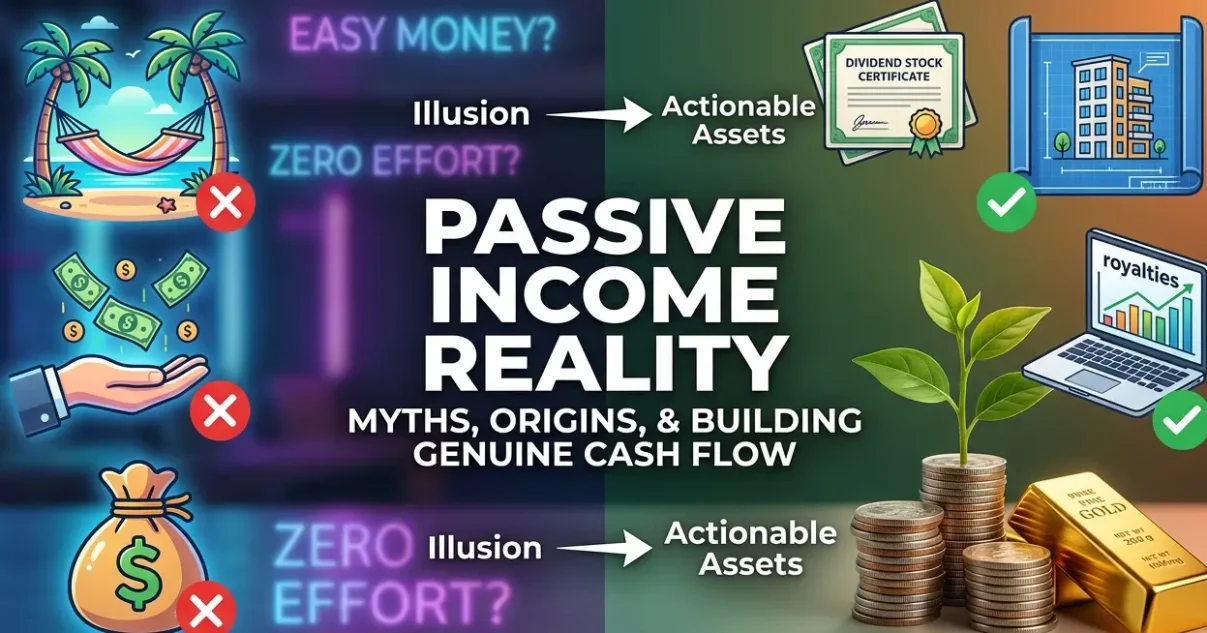
Passive income isn’t some magic money genie. It always requires a significant upfront investment of effort, capital, or creating robust systems. But once that hard work is done? That’s when the real fun begins. Whether you’re interested in dividend investing or the messy world of real estate, we’re covering all the actionable insights here.
The Big Passive Income Myth: What the Internet Gets Wrong
The classic promise is simple: Money flows in with zero effort. Marketers practically sell it as a shortcut to being wealthy.
“Start a YouTube channel and watch the passive income roll in!”
“Launch a dropshipping store and put it on autopilot for passive income!”
“Buy a rental property and enjoy the passive income stream!”
Reality Check: That’s mostly a lie.
YouTube channels can take years to gain traction, and monetization isn’t guaranteed—most creators earn literal pennies. You’re trading time for a delayed, often tiny, paycheck. Dropshipping? That means answering customer service emails at 2 a.m., dealing with supply chain headaches, and fighting off platform ad bans. That’s not passive; that’s a job with a fancy name.
And property investment? Unless you set up the perfect structure, it’s a full-time gig. Late-night tenant calls, emergency repairs, taxes, and insurance forms will quickly kill your “passive” dream. Most of what the gurus call passive income is just front-loaded work in disguise, with profits that are frustratingly delayed.
The Surprising Origin: Tax Loophole, Not Wealth Strategy
Here’s a kicker: Passive income wasn’t even born as a strategy for building wealth. It actually started as a legal term created by the IRS back in the 1980s—and it was meant to stop rich people from dodging taxes.
How did they do it? Wealthy folks used “passive loss” loopholes. They’d invest in real estate partnerships without lifting a finger, and those paper losses (created by things like depreciation) would offset their regular, “active” income.
Picture a high-flying lawyer earning $500,000. They invest in a partnership that loses $200,000 on paper. Suddenly, their taxable income drops to $300,000. They weren’t losing real cash, but they were saving a fortune on taxes. They stacked these investments to avoid millions.
The IRS cracked down in 1986. They ruled that passive losses couldn’t offset active income anymore. It became an official IRS classification. Only after that did marketers grab the term and turn it into the financial fantasy we know today.
The Reality: Cash-Generating Assets, Not Magic
Let’s face it: No income is truly passive without some initial input. What people actually mean when they say “passive income” is a cash-generating asset. And assets need one of three things: capital, time, or specialized expertise.
The question you need to ask isn’t, “How do I get passive income fast?” It’s, “How do I build assets that produce a reliable cash flow?”
Here are five proven asset types, along with their caveats-
1. Dividend Investing: The Classic Starter
This is usually the first thing on any passive income list. You buy shares in a stable company (a “blue-chip” stock like Apple or Coca-Cola), and they share their profits with you quarterly. You just hold the shares and collect the checks. Sounds great!
The Caveat: Dividends scale directly with how much you invest. A $10,000 portfolio with a 4% yield only kicks out about $400 a year. That’s barely a monthly grocery run, not financial freedom. To get a truly life-changing $40,000 annually at 4%, you need a $1 million portfolio.
Dividend income is truly hands-off after the purchase, but you need serious capital to make it meaningful. Focus on “dividend aristocrats”—companies that consistently raise their payout—and reinvesting those dividends to harness the power of compounding.
2. Real Estate: Passive Income with Systems
The dream: Buy a place, rent it out, and watch the checks roll in.
The Caveat: Without systems, real estate is hard labor. The toilet breaks at midnight, the tenant stops paying, and you have to deal with endless repairs, taxes, and insurance. Managing one property solo isn’t passive—it’s a second job.
The wealthy make it passive by scaling and delegating. They use leverage to buy multiple properties and immediately hire a property manager to handle leasing, maintenance, and accounting. This structure makes it passive, but it demands serious capital, planning, and expertise upfront.
Tip: If you’re starting out, REITs (Real Estate Investment Trusts) are a great passive exposure option. You buy shares in a fund, get the dividends, and never have to take a tenant call.
3. Royalties and Licensing: Ideas That Pay
This is where your creativity earns you money. Write a book, license a piece of software, or produce music. Others use your intellectual property, and you earn a recurring royalty.
The Caveat: Exposure is everything. Mariah Carey’s “All I Want for Christmas Is You” still earns her millions annually because she had the brand, the marketing, and the timing. Unknown artists and authors often struggle to earn enough to cover their coffee budget.
Royalties compound with hits. The key is creation plus distribution. You have to build an audience first. However, once a great asset is created (like a hit song or a vital piece of software), the income can be incredibly “sticky” and long-lasting.
4. Digital Products and Content: Build Once, Sell Forever
The siren song of the digital age: Create an online course, an e-book, or a video, and sell it an infinite number of times.
The Caveat: There are two pitfalls here. First, if you have no audience, your content will simply die unseen. Second, most digital products have a short shelf life—interest peaks for a few weeks, and then the views drop off.
To sustain this, you need constant creation and promotion. You have to update your courses, run ads, and keep marketing. The income is passive only once you’ve automated the sales funnel. Digital assets can build an empire, but only if you put in the promotional effort.
5. Private Equity and Limited Partners: The Elite Track
The wealthiest often invest in existing private businesses as a “limited partner.” They put up the capital, and the operating partners handle all the work. They get a cut of the profits, usually earning 8-20% annually.
The Caveat: The barriers to entry are huge. We’re talking $100,000+ minimums and funds that lock up your money for several years. This is “passive income” for accredited investors with vetted deals and connections. If you’re not in that circle yet, this isn’t your starting point.
The Truth: Passive Income Helps You Stay Rich, Not Get Rich
Passive income is not a jackpot; it’s a financial firewall.
You absolutely must build your active income first. That’s the engine that covers your burn rate (your monthly living costs). The majority of people work actively just to pay the bills. In the US, only about one in five households even receives passive income, and the median amount is around $4,200 a year—roughly $350 a month. That’s nice, but it’s not freedom.
Financial freedom is when your reliable passive income streams cover your low monthly needs. So, earn actively, spend wisely, and continuously buy assets. The people whose passive income seems effortless now are the ones who paid the price (time, money, sacrifice) years ago.
Front-load the sacrifice for backend freedom.
Building Your Real Passive Income Portfolio
Your passive income journey needs to start with an honest assessment of your resources: time, money, and skills.
No Capital? Invest your time in digital products or content creation. That’s your sweat equity for future passive income.
Some Savings? Dividend stocks are your slow, steady path. It builds gradually, but it’s reliable.
Ready to Scale? Real estate, especially with a professional property manager, can create strong, growth-focused streams.
Don’t forget to diversify. Combine stability (dividends) with growth (real estate) and creativity (royalties) to balance your risk. Track your progress, consistently reinvest your earnings, and let compounding work its magic over decades.
The future you’re working toward will absolutely thank you for committing to this reality today.