
The Broken Promise of India’s IT Sector: Is the “Dream Job” Turning into a Nightmare?

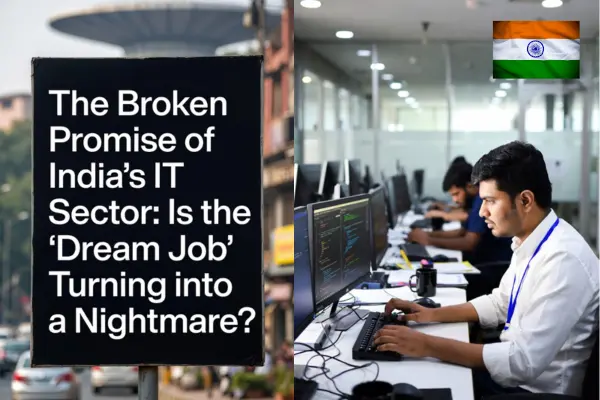
Once upon a time, in middle-class India, there was a golden rule: “Study engineering, get an IT job, and your life is set.”
For decades, the Indian IT sector was the ultimate savior. It was the gateway to foreign trips, buying your first car, and lifting entire families out of financial struggle. But today, if you look behind the shiny glass buildings and the ID cards, a darker, much harsher reality is emerging.
Recent viral images of hundreds of trainees scrambling for transport after delayed onboarding at Infosys have sparked a firestorm of anger. But this isn’t just about one company. From unpaid “benches” to 14-hour workdays, the sector is going through a painful crisis.
If you are a student, a parent, or an experienced professional, you need to know the truth. This isn’t just a rant; it is a deep dive into the real stories, the hard data, and the survival guide you need right now.

1. The Onboarding Trap: Hired, Celebrated, but Unemployed
Imagine this: You study hard for four years, your parents take out a hefty loan of ₹5 lakhs to pay your fees, and finally, you crack the campus interview. You get an offer letter from a tech giant like Infosys or Wipro. There are celebrations, sweets are distributed, and you feel safe.
But then, the silence starts.
The Story of Kartik
Meet Kartik Kumar from Jabalpur. In April 2022, he was on top of the world with an offer letter in hand. He thought he could finally start paying off his education loan.
Fast forward to late 2024: Kartik has paid only two EMIs. Why? Because he hasn’t joined yet. In the company’s records, he is on the “Onboarding Bench.” This is a fancy corporate term that essentially means: “We selected you, but we don’t have work for you yet, so you won’t get paid.”
Why is this happening?
It’s a supply and demand issue. During the pandemic, IT companies over-hired. Now, with global economies slowing down, clients in the US and Europe are cautious. Projects are getting delayed, and freshers are treated as “buffer stock.”
The Real Cost-
- Mental Trauma: Thousands of students are stuck in limbo for 2–3 years.
- Financial Ruin: Banks don’t care about offer letters; they want their EMI.
- Frozen Salaries: According to reports from the Times of India, freshers’ salaries are stuck at the same ₹3-4 Lakhs Per Annum (LPA) range they were a decade ago, while the cost of living has skyrocketed.
2. The Great Reward Drought: “121 Hours of Work for a 1% Hike”
If you think getting the job is the hardest part, ask the people who are already inside. The days of 50% salary hikes and double promotions are history.
Recently, a Reddit post went viral where an employee with three years of experience shared a heartbreaking reality-
“After working 121 hours a week and sacrificing my weekends, my reward was a 1% hike.”
This is not a joke. It is the new industry standard.
The Hike Reality Check (2024 Data)
Here is a snapshot of what increments look like across major service-based companies based on recent employee feedback-
| Company | Average Hike | The Reality |
| TCS | 4% – 7% | Strictly for top performers; tied to complex upskilling tests. |
| Infosys | 3% – 5% | Hikes have been frozen for long periods; some report 11% total growth in 4 years. |
| Wipro | 1% – 5% | Heavy delays; hikes are often skipped for “average” ratings. |
| HCL | 1% – 5% | Very low averages, regardless of hours put in. |
The CEO vs. Employee Gap-
While a fresher struggles to pay rent in Bengaluru or Pune, the salaries of CEOs in these same firms have jumped by 1,550% over the last 10 years. The wealth gap is widening, and the average employee is paying the price.
3. Toxic Culture: When Work Becomes Dangerous
“Burnout” is a mild word for what is happening. We are seeing a health crisis.
A recent survey by India Today covering 1,450 IT professionals revealed shocking numbers-
- 83% feel constantly exhausted.
- 72% work more than 48 hours a week.
- 25% are pushing past 70 hours a week.
The Tragic Cost of Pressure-
The pressure isn’t just about emails; it’s putting lives at risk.
- We heard the tragic story of a 25-year-old whose father passed away in the ICU because the employee was denied leave.
- On September 29, an HCL employee suffered a fatal heart attack inside the office washroom.
The culture of “Compulsory Unpaid Learning” adds to this. Employees are expected to work 9-10 hours and then spend their nights and weekends completing mandatory courses. If you refuse, your rating drops. If you complain to HR, you might be forced to apologize for “creating trouble.”
4. The “40-4 Syndrome”: No Country for Old Men (or Women)
There was a time when an IT job was as secure as a government job. You could stay for 20 years and retire peacefully. That era is over.
In the last two years alone, the “Big Four” (TCS, Infosys, Wipro, Cognizant) have reduced their headcount by nearly 42,000 people.
What is the 40-4 Syndrome?
This is a terrifying trend for mid-career professionals.
- Age: 40 Years old.
- Salary: ₹4 Lakhs.
- Result: You are the first to be fired.
Companies prefer to hire two fresherswith lower salary rather than keep one senior manager at ₹4 lakhs. Data shows that 50% of the IT workforce is now between 20-35 years old. If you are over 40, you are considered “expensive” and “slow to adapt,” regardless of your actual skill.
The Layoff Tsunami-
Microsoft laid off 50,000 people to shift focus to AI. Google and Amazon followed. If you are in your 40s, with home loans and children’s education fees, the lack of job security is a ticking time bomb.
5. The AI Revolution: Adapt or Perish
Artificial Intelligence (AI) is not coming; it is already here, and it is hungry for jobs.
Studies from Cornell University have shown that AI can code 55.8% faster than human programmers. Microsoft is already generating 30% of its code using AI tools.
Who is at risk?
- Coders: If your job is just writing basic Java or C++ code, AI can do it in seconds.
- Middle Management: Tools like Asana and Power BI are automating reporting and team management.
The founder of Infosys, Narayana Murthy, advised young Indians to “Learn, Unlearn, and Relearn.” This is no longer motivational quotes; it is a survival instruction. Skills that were hot 3 years ago are obsolete today.
6. The Supply Shock: From Dream Factory to War Zone
Let’s look at the math.
Last year, India produced roughly 15 lakh engineering graduates.
How many IT jobs were available?
Approximately 70,000.
Do you see the gap?
This oversupply allows companies to treat people poorly because they know there is a line of thousands waiting outside the door. In Pune recently, 3,000 people lined up for a walk-in drive that had only 100 spots. It was a stampede.
It wasn’t always like this. In 1999, the Y2K bug launched Indian IT onto the global stage. It contributed massively to our GDP and gave rise to the middle class. But the “glory days” of easy money are gone.
7. How to Survive: A Practical Guide
So, is it all doom and gloom? No. But you have to change your strategy. You cannot rely on loyalty or hard work alone.
A. Master Communication
In a sea of coders, the one who can speak and write well wins. A survey showed that 62% of Indians make grammatical errors in professional emails, which kills credibility.
- Bad: “Respected sir, myself will not be available.”
- Good: “Dear Sir, I am writing to inform you that I will be unavailable tomorrow.”
Tool Tip: Use tools like QuillBot. It helps fix grammar and tone instantly. If you can communicate your value clearly to US/UK clients, you become harder to fire.
B. Upskill Aggressively
Don’t just be a “Java Developer.” Be a “Cloud Architect” or an “AI Specialist.”
- Learn to use AI tools like GitHub Copilot.
- Focus on niches like Cybersecurity or Data Engineering.
C. Build a “Plan B”
Never rely on a single paycheck.
- Start freelancing on weekends.
- Look for remote jobs with foreign startups (they pay in Dollars/Euros and often have better culture).
- Save an emergency fund that covers 6-12 months of expenses.
The Wake-Up Call
The Indian IT sector is no longer a nursery that will take care of you; it is a jungle. The toxicity, the benching, and the low hikes are the new reality.
However, survival is possible. It requires you to stop being emotional about your employer and start being strategic about your career. Treat yourself as a business. Upgrade your product (skills), market yourself better (communication), and always keep a backup plan.
What is your experience with the current IT market? Are you stuck on a bench or facing burnout? Share your story in the comments below—let’s discuss.
[Disclaimer: Data cited in this article is sourced from Times of India, India Today, and Reddit community discussions representing real employee experiences.]