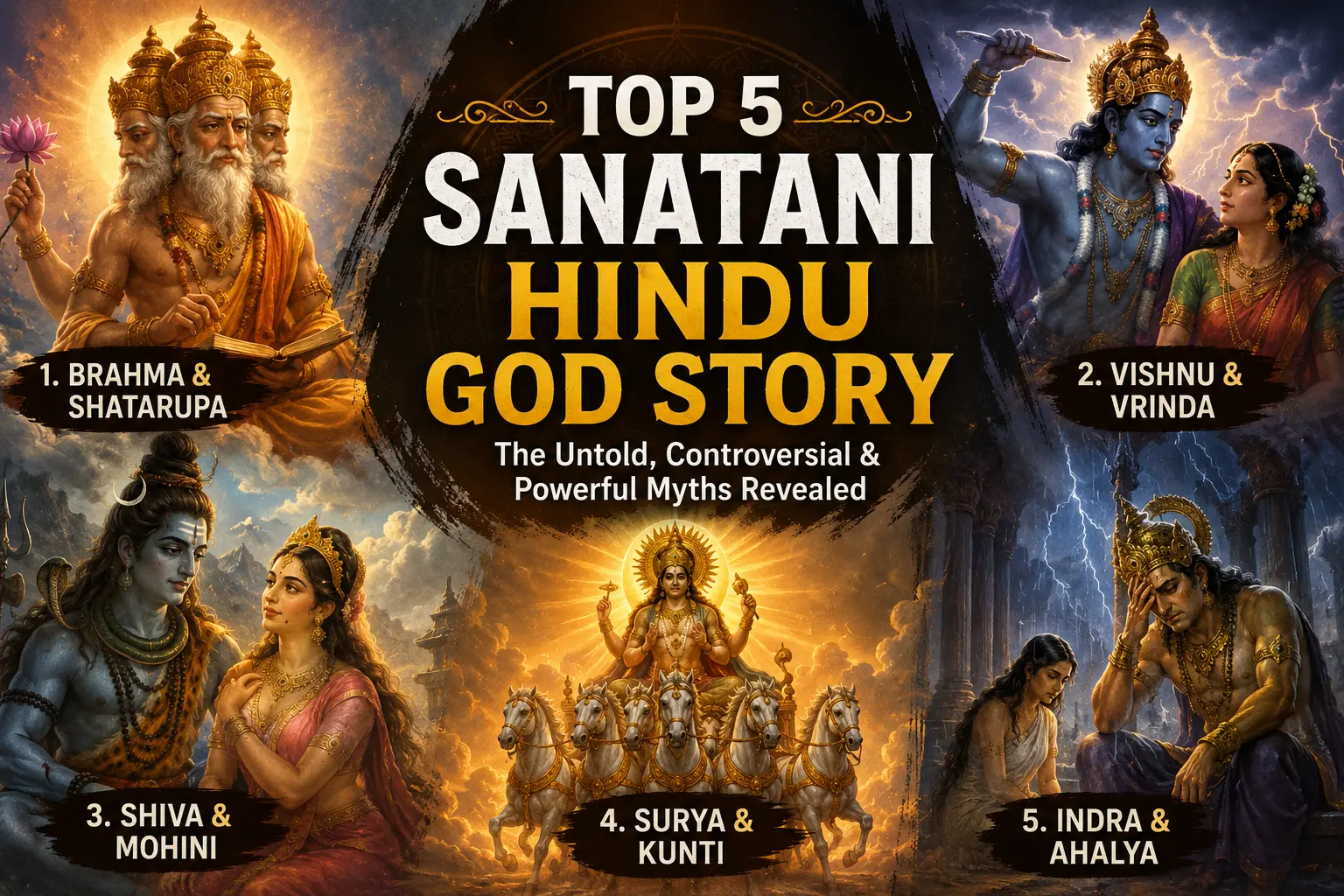
Top 5 Sanatani Hindu God Story

Some of the most intense, controversial, and heavily debated stories in Hindu Puranic literature. If you read these Hindu texts through a modern ethical lens, many of these encounters involve deception, non-consensual acts, or severe abuses of power.
Ancient mythologies—whether Hindu, Greek, Norse, or Egyptian—rarely function as sanitized moral fables. Instead, they often reflect complex cosmic allegories, tragic flaws, and raw human dilemmas. In the Puranas, even powerful deities face curses, loss of worship, and severe karmic consequences when they cross moral boundaries.
Here is how these specific narratives are actually framed and understood in the textual traditions:
1. Brahma and Shatarupa (Saraswati)
In the Matsya Purana, Brahma creates a female form, Shatarupa (often conflated with Saraswati as a goddess of knowledge), and becomes consumed by desire for his own creation.
- The Textual Context: The narrative treats this obsession as a profound spiritual and moral failure. Within Hindu tradition, this specific act is the textual explanation for why Brahma is stripped of his status, has almost no temples dedicated to him, and is generally not worshipped by devotees.
2. Vishnu and Vrinda (Jalandhara’s Wife)
The demon king Jalandhara was invincible in battle as long as his wife, Vrinda, remained perfectly faithful. To stop Jalandhara from destroying the universe, Vishnu used a classic ancient warfare trope: shape-shifting deception. He disguised himself as Jalandhara to break her vow of fidelity.
- The Textual Context: This is an act of cosmic espionage rather than physical violence, but it remains a deeply tragic story. Upon realizing the trick, a furious Vrinda cursed Vishnu to turn into stone (the Shaligram) and immolated herself, later manifesting as the sacred Tulsi plant.
3. Shiva and Mohini
When Vishnu assumed the female avatar of Mohini, Shiva was entranced by her form. Their union resulted in the birth of the deity Ayyappa (Hariharaputra).
- The Textual Context: In texts like the Bhagavata Purana, this interaction is characterized as Lila (divine play) and a consensual merging of cosmic energies between two equal aspects of the Divine (Hari and Hara), rather than a non-consensual assault.
4. Surya and Kunti
In the Mahabharata, a young Kunti tests a secret mantra given to her by Sage Durvasa out of pure curiosity. The mantra forces any god she calls upon to grant her a child. She inadvertently summons Surya (the Sun God).
- The Textual Context: Kunti is terrified and begs him to leave, but the cosmic power of the mantra binds them. Surya assures her that the conception will happen mystically, preserving her physical virginity and honor. The resulting child is the warrior Karna.
5. Indra and Ahalya
Indra, the king of heaven, lusted after Ahalya and disguised himself as her husband, Sage Gautama, to sleep with her.
- The Textual Context: The texts explicitly condemn Indra for this act of fraudulent consent. When Gautama catches them, he delivers a severe curse that disfigures Indra and turns Ahalya to stone until she is spiritually purified centuries later by Rama. Indra is frequently portrayed in the Puranas as a deeply flawed ruler driven by insecurity and lust, serving as a cautionary tale rather than a role model.
6. Soma and Tara
Soma (the Moon god) abducted Tara, the wife of the gods’ guru, Brihaspati, which triggered a massive celestial war.
- The Textual Context: Like the story of Indra, this is depicted as a major transgression born of arrogance and passion, resulting in massive chaos and divine intervention to restore cosmic order.
Ancient Hindu Sanatani Puranic texts are complex tapestries. They do not present gods as flawless, infallible entities; instead, they frequently depict them committing grave errors, facing severe curses, and suffering the consequences of their actions to illustrate that cosmic laws apply to everyone.