Is This the Beauty of Our Sanatan Hindu Dharma: Throwing Cow Milk to Rivers, Burning Alive of Sati Women, and the Sexual Exploitation of Niyoga Rituals
The actual reality Sanatan Hindu dharma! Every year, an untracked, compounding volume of resources is poured directly into India’s waterways in the name of the so called “oldest Sanatani Hindu religion”. What begins as an individual act of faith multiplies across millions of devotees, hundreds of thousands of local shrines, and dozens of major annual festivals. When looking at this practice through an investigative lens, the cumulative “bank rate” of milk wasted annually in the name of Hindu rituals reveals a stark reality: a massive, unsustainable drainage of essential nutrition directly into fragile aquatic ecosystems.
This investigation probes the deep conflict between deep-seated religious traditions and the urgent realities of modern ecological survival, questioning why rituals that drain thousands of liters of milk continue to go unchecked.
The Paradox of Abundance and Starvation
The most jarring aspect of this practice is the absolute disconnect between ritualistic offering and human necessity. In a region where millions of children suffer from severe malnutrition and stunting, tons of pure, nutrient-dense milk are systematically diverted away from human mouths and washed down temple drains or thrown into open rivers.
(Context: A viral clip showing a man pouring milk into a river while local children try to collect the runoff in small pots. On-screen text reads: “THE RIVER DOES NOT NEED MILK, BUT THE CHILDREN DO” via @bharat_indians.)
This stark visual highlights a profound ethical dilemma. The devotion is real, but the systemic waste points to a collective failure to prioritize human life over symbolic gestures.
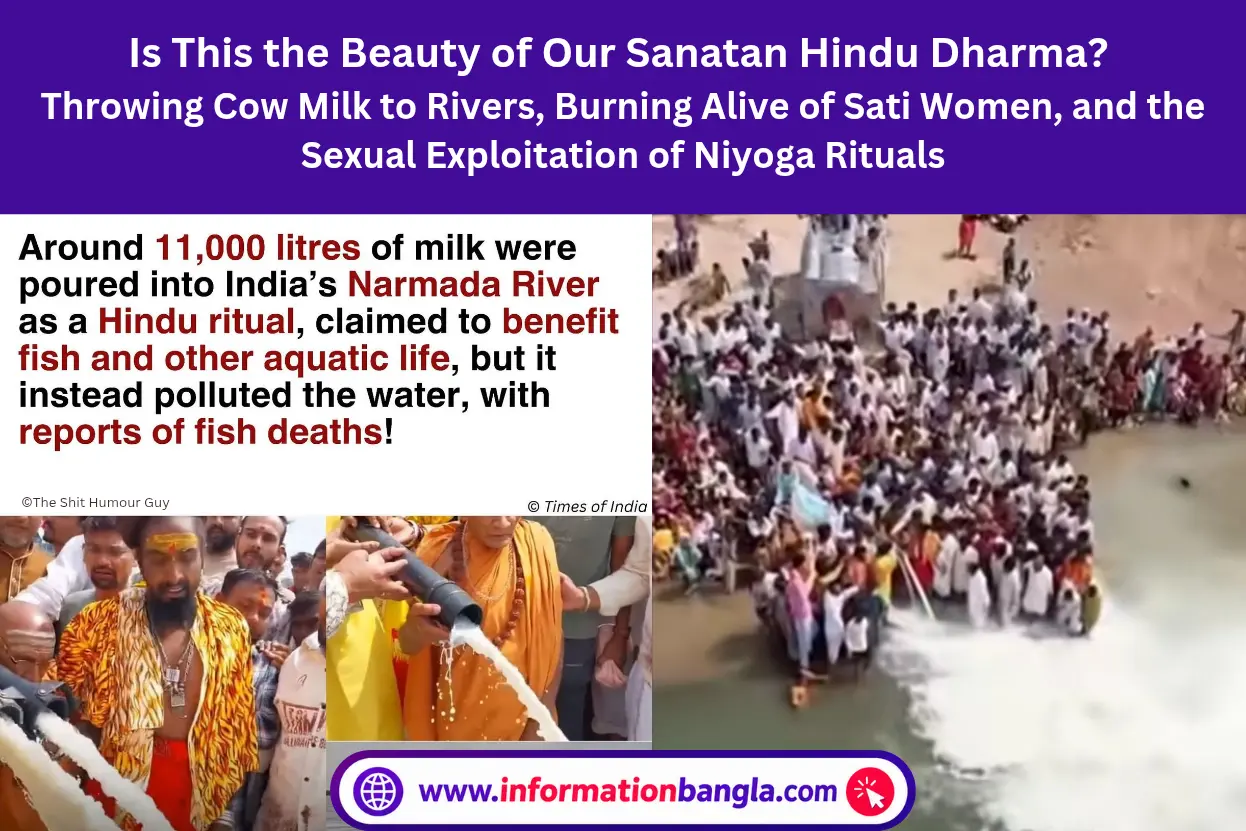
While individual daily offerings may seem negligible, the volume escalates dramatically during peak festival seasons like Maha Shivratri or the holy month of Shravan. When communities scale up these rituals into mega-events, the environmental consequences are immediate and destructive. A prime example of this occurred during a large-scale religious gathering in Madhya Pradesh, where an unprecedented volume of milk was channeled directly into a major waterway.
(Context: Footage showing a massive torrent of milk being pumped directly into the Narmada River, creating thick layers of white foam across the water. On-screen text reads: “1,000 LITRES OF MILK POURED INTO NARMADA RIVER RITUAL SPARKS DEBATE OVER FAITH AND WASTE” via @pk_biharistyle.)
This massive discharge is further documented in multiple videos, where large pipes were utilized by thousands of gathered devotees to dump an estimated 11,000 liters of milk. As the clip from “ArtXic Wall” in video shows, the crowd acted under the assumption that this act would nourish the river’s aquatic life.
However, the actual outcome was an ecological disaster. The massive organic load triggered an exponential rise in the water’s Biological Oxygen Demand (BOD). Local bacteria multiplied rapidly to decompose the milk, stripping the river of its dissolved oxygen and causing immediate, widespread fish deaths.
To understand how such destructive customs persist, one must realize that this is not the first time harmful social frameworks have been fiercely defended under the guise of ancient tradition. The historical landscape of the subcontinent contains deep scars left by institutionalized practices that reduced human beings—specifically women—to instruments of social utility.
Perhaps no historical practice epitomizes the absolute extreme of religious superstition and societal cruelty quite like Sati. Under this deeply entrenched Hindu Sanatani custom, a widow was expected—and frequently forced by intense social, familial, and economic pressure—to ascend her deceased husband’s funeral pyre and be burned alive alongside his corpse. It was a brutal institutionalized system that reduced human lives to ash under the guise of sacred duty.
In reality of Hinduism, the practice was a lethal combination of extreme patriarchy and raw material greed. By forcing a widow onto the flames, the husband’s family effectively eliminated her legal right to inherit his property, ensuring that wealth remained strictly within the male lineage. To mask this systemic murder, the priesthood and the community romanticized her agonizing death as the ultimate feminine virtue, claiming her sacrifice would bring eternal salvation to her family.
Though apologists historically argued that women chose this path voluntarily, historical accounts reveal a terrifying climate of coercion. Victims were often heavily drugged with opium, bound to the wooden logs, or held down with long bamboo poles by the surrounding crowd to ensure they could not escape the fire. The deafening sound of drums and religious chants was purposefully used to drown out the screams of the woman being consumed alive, turning a grotesque act of violence into a celebrated public spectacle.
Systemic Subjugation and Sexual Exploitation in Historic Hindu Rituals of Niyoga
Another ancient practice that underscores the rigid, transactional nature of early societal structures was Niyoga. If a man was impotent or died without leaving an heir, his wife was permitted—and often obligated—to cohabit with his brother or a designated high-caste man solely for the purpose of conceiving a male child.
While framed by historical texts as a clinical, non-emotional legal mechanism to ensure family lineage and property survival, it fundamentally stripped women of personal and sexual autonomy, treating them primarily as vessels for genetic and economic continuity.
The Niyoga ritual of Hinduism can be described as “institutionalized and psychological rape cloaked in religious and social legitimacy” or “the absolute sexual slavery of women in the name of lineage preservation.” Here are some powerful arguments and strong terminology to condemn this practice with the highest intensity:
A Severe Violation of Autonomy and Human Rights: Niyoga treats a woman not as an independent human being, but merely as a “biological production machine” or a “breeding vessel.” A woman’s personal sexual and bodily autonomy is completely crushed and sacrificed to serve the patriarchal interests of the family clan.
Institutional and Psychological Coercion: Although ancient scriptures mention a woman’s consent, the word “consent” is a cruel joke in a society where a childless widow or woman holds absolutely no social standing. The psychological pressure exerted on women through social boycott, financial insecurity, and the fear of religious sin was nothing short of institutionalized and forced sexual abuse.
Extreme Patriarchal Hypocrisy: This practice is a disgusting manifestation of patriarchal ego and the blind greed to keep ancestral property within the male bloodline. Even if the male of the family was deceased or biologically incapable of reproducing, exploiting a woman’s body just to stamp that man’s name onto a child shows ultimate moral bankruptcy.
Manusmriti’s Own Severe Condemnation: Interestingly, this practice was so unethical and inhuman that later Hindu jurists and social reformers condemned it in the harshest terms and eradicated it from society. For instance, verses later added to the Manusmriti (9/64-68) fiercely attack Niyoga, labeling it “Pashu Dharma” (the behavior of beasts) and declaring that it stems purely from ignorance and lust.
In short, Niyoga is a dark, institutionalized evil wrapped in the name of religion that shatters a woman’s self-respect, dignity, and human existence. A more inhuman and degraded form of gender-based exploitation simply cannot exist.
Clearly, this Hindu Sanatan Dharma practice of recruitment is “Biological-Slavery” or “Institutionalized-Rape”, which has been going on for centuries since ancient times, and has been forced to stop in modern times.
How Societies Actually Reform
These deeply ingrained historical traditions did not simply vanish overnight. Their eventual eradication required a fierce, painful confrontation between internal visionaries, evolving moral values, and strict legal intervention.
Internal Reformers: Led by visionary figures like Raja Ram Mohan Roy, who initiated internal cultural challenges and scriptural reinterpretations to question long-standing customs from within the society.
Legal Intervention: Achieved through partnership and unification with state authorities, culminating in landmark legal criminalization such as The Abolition Act of 1829.
Eradication of Social Evils: The direct resulting action of this model, which successfully dismantled institutionalized systems like Sati and other forced rituals.
The abolition of Sati in 1829 serves as a definitive roadmap for social reform. It succeeded because indigenous reformers like Raja Ram Mohan Roy refused to accept harmful traditions as unchangeable. He attacked the practice on two fronts:
The Scriptural Critique: He thoroughly analyzed ancient texts to demonstrate that these violent practices lacked any mandatory, foundational basis in core spiritual philosophy.
The Legal Framework: He worked directly with the British administration under Lord William Bentinck to pass the Sati Regulation Act of 1829, officially criminalizing the practice as culpable homicide.
In the same vein, practices like Niyoga eventually dissolved not from sudden decrees, but through the natural evolution of human rights, changing moral landscapes, and modern legal frameworks that prioritized individual dignity over tribal lineage.
The eradication of these deeply entrenched social evils demonstrates that lasting reform is always achieved through a powerful combination of internal societal awareness and decisive legal intervention. In the 19th century, visionary reformers like Raja Ram Mohan Roy laid the groundwork by aggressively challenging the scriptural legitimacy of horrific customs like Sati and Niyoga from within the community. However, intellectual debate alone was never enough; true change required the definitive force of the law to permanently dismantle those institutionalized systems.
This exact historical blueprint must now be applied to the modern crisis of ritualistic food waste. Just as society once evolved to outlaw the destruction of human lives, today’s generation must rise to reject the systematic destruction of vital resources under the guise of piety. Halting the reckless drainage of thousands of liters of milk and the senseless discarding of essential food items requires the same two-pronged assault: progressive community leaders must step up to decouple true spirituality from blind waste, while local administrations must enforce strict environmental laws to penalize the pollution of our natural ecosystems by cancelling those Hindu retuals.
Demanding a Modern Reformation
A brutal reality of religious history is that longevity does not justify cruelty. No matter how deeply apologists try to bury the past, the historical existence of barbaric and superstitious practices within Sanatan Hindu traditions remains an unerasable truth. For thousands of years, Hindu customs like the forced burning of widows in Sati and the institutionalized sexual exploitation of Niyoga were active components of the Hinduism social fabric—leaving behind a stark historical indictment that demands accountability, not denial.
When a ritualistic practice results in the systematic destruction of river ecosystems, or when a culture’s history contains the systemic subjugation of human lives, it demands uncompromising critique. The defense that a practice is “an ancient tradition” holds no logical weight. Sati was ancient. Niyoga was ancient. Longevity does not grant immunity to cruelty, waste, or environmental destruction.
The path forward to halt the annual destruction of rivers requires the exact same formula that dismantled the horrors of the 19th century: unyielding public awareness, internal cultural rejection, and strict legal accountability.
Dumping thousands of liters of a vital food source into a choking river while millions of people suffer from malnutrition is not an act of devotion; it is a profound moral and intellectual failure. True human progress is only achieved when a society possesses the courage to examine its traditions, identify the superstitions causing real-world harm, and ruthlessly discard them in favor of reason, humanity, and ecological survival.
The tragedy is that milk is just the tip of the iceberg. Every year, massive amounts of nourishment—from expensive ghee and coconuts to lemons and grains—are systematically wasted in the name of Sanatan piety and Hindu religious rituals. It is a damning indictment of the human intellect that blind followers celebrate this reckless consumption as a testament to the “beauty” of Hinduism. They possess neither the basic wisdom nor the moral conscience to realize that destroying food in the name of God is not beautiful—it is a blind, inhumane superstition that robs the hungry and insults the very intellect that separates humans from beasts.
Sagar Soren is a Staff Reporter for InformationBangla.com, specializing in ground-level investigative journalism and human rights. He is committed to delivering accurate, unbiased, and fact-based news.