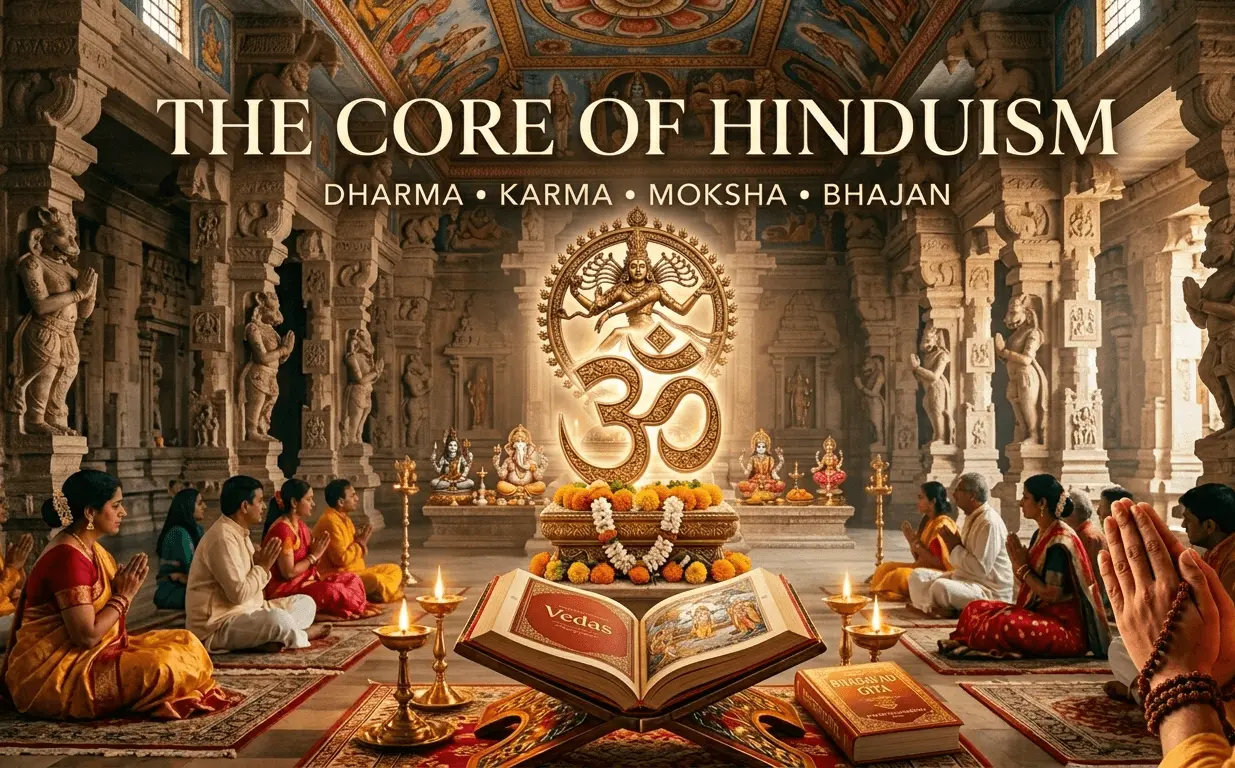
Hinduism is one of the oldest religions in the world. It is not only a religion in the usual sense, but also a way of life for millions of people. It has no single founder, no one holy book that is followed by everyone in the same way, and no one fixed rule for all believers. Because of this, Hinduism can seem very broad and complex. But when we look closely, we can find some clear ideas at its center. The core of Hinduism is about truth, duty, karma, dharma, devotion, and the search for liberation.
At the heart of Hinduism is the idea that there is one ultimate reality behind everything. Many Hindus call this supreme truth Brahman. Brahman is believed to be everywhere and in everything. It is not a god in the simple human form, but the highest power that gives life to the universe. At the same time, Hinduism also allows people to worship many gods and goddesses. This may seem confusing at first, but the meaning is simple. The many gods are seen as different forms or expressions of the one divine truth. This is one reason Hinduism is so flexible and wide in its thinking.
Another important part of Hinduism is dharma. Dharma means duty, right conduct, moral law, and the proper way to live. For Hindus, life is not just about personal happiness. It is also about doing what is right, being honest, showing respect, and fulfilling one’s responsibilities. Dharma is different for different people depending on their age, family role, and place in life. For example, a child has one duty, a parent has another, and a student has another. The idea is that every person should live in a way that brings order, balance, and goodness to the world.
Karma is also central to Hinduism. Karma means action and the results of action. In simple words, every good or bad deed has consequences. What a person does, says, and thinks all matter. Good actions lead to good results, while harmful actions bring suffering. This idea teaches people to be careful about how they live. It also gives hope, because it says that life is fair in a deeper sense. Even if someone does not receive justice immediately, karma reminds us that actions never disappear. They return in one form or another.
Closely connected to karma is the belief in rebirth. Hindus believe that the soul, called atman, does not die when the body dies. Instead, it is born again in another life. This cycle of birth, death, and rebirth is called samsara. The soul keeps moving through this cycle until it becomes free. The idea behind rebirth is that life is a journey of learning. Every life gives a soul a chance to grow, improve, and move closer to truth.
The final goal in Hinduism is moksha, which means freedom from the cycle of rebirth. Moksha is not just about escaping suffering. It is also about becoming one with the highest truth and realizing the true nature of the soul. In many Hindu teachings, people suffer because they forget who they really are. They become attached to money, pride, pleasure, and temporary things. Moksha comes when a person sees beyond all this and understands the deeper spiritual truth. This is why Hinduism teaches self-control, wisdom, and inner peace.
Devotion, or bhakti, is another major part of Hinduism. Many Hindus feel a deep personal love for God. They pray, sing, meditate, and offer worship with sincere hearts. Bhakti makes religion feel close and emotional, not cold or distant. A person may worship Krishna, Shiva, Lakshmi, Durga, Rama, or another divine form, but the feeling behind it is often the same: love, trust, and surrender to God. This devotion helps people feel connected to something greater than themselves.
Hinduism also gives great value to meditation, self-discipline, and knowledge. Some people follow the path of yoga, not only as exercise, but as a spiritual practice. Yoga in its original meaning is about controlling the mind and body so a person can reach higher understanding. There are different paths in Hinduism, such as the path of knowledge, the path of devotion, the path of action, and the path of meditation. This shows that Hinduism does not force everyone into one single method. It allows different personalities and temperaments to find their own way.
Respect for life is also an important Hindu value. Many Hindus believe in ahimsa, which means non-violence or not causing harm. This idea encourages kindness toward people, animals, and all living beings. It is one reason why vegetarianism is common among many Hindus. Ahimsa does not always mean complete avoidance of conflict in every situation, but it does mean that violence should never be taken lightly. A good life should be based on compassion and care.
Family, tradition, and respect for elders also play a strong role in Hinduism. Life is often seen as connected, not separate. A person is not only an individual. He or she is also part of a family, community, and larger moral order. Because of this, Hinduism teaches people to think beyond themselves. A person should honor parents, care for children, respect teachers, and serve society in a useful way. In this sense, Hinduism is not only about private belief. It is also about how one lives with others.
Another beautiful thing about Hinduism is its openness to many forms of worship and belief. Some Hindus are deeply devotional. Some focus on philosophy. Some follow rituals. Some meditate quietly. Some see God in a personal form, while others see God as formless. This variety is not seen as a weakness. Instead, it is one of Hinduism’s greatest strengths. It recognizes that human beings are different, and that spiritual truth can be approached in many ways.
Even though Hinduism has many branches, stories, temples, festivals, and traditions, its main message remains clear. Live truthfully. Do your duty. Understand that every action matters. Respect the divine in all its forms. Control your desires. Practice kindness. Seek wisdom. And remember that life has a deeper purpose beyond temporary success or pleasure.
In the end, the core of Hinduism is not just about rituals or names of gods. It is about the journey of the soul. It asks human beings to live in a better way, think in a deeper way, and connect with the eternal truth behind the world. Hinduism teaches that life is sacred, action has meaning, and the soul can rise above suffering through knowledge, devotion, and righteous living. That is why Hinduism has remained alive for thousands of years. It speaks not only to the mind, but also to the heart and the spirit.
If you want, I can also turn this into a more “student essay” style with simpler words and a stronger introduction and conclusion.
A passionate content creator and technology enthusiast, who has been writing on various IT and informational topics for the past 3+ years. As a regular writer for Information Bangla, he loves to present complex topics to the readers in simple language.