
“Better to Die Than Take Muslim Money”: How BJP-RSS Backed Hindutva Extremists are Enforcing Segregation and Communal Boycotts against minority Muslims on the Streets of India

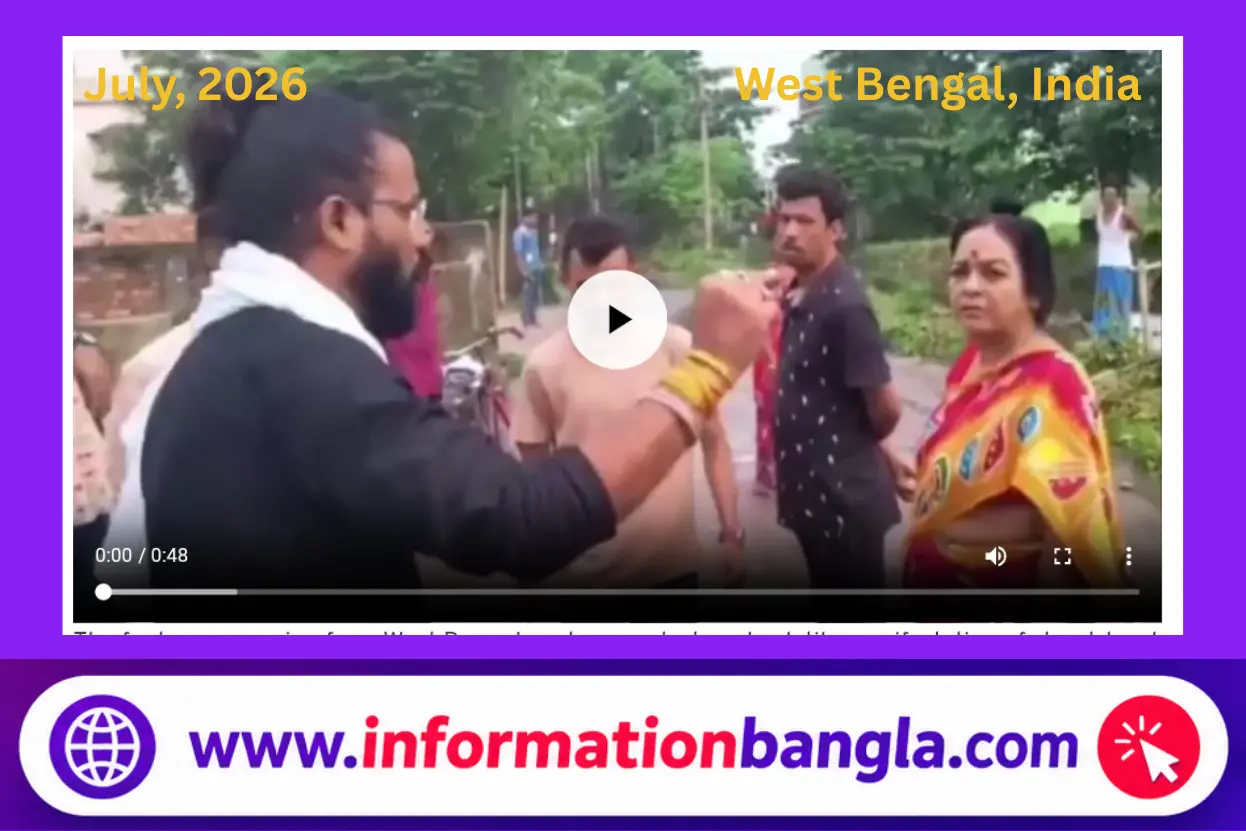
Under the shadow of the BJP-RSS’s new political dispensation, a deeply alarming strategy of residential and commercial segregation is taking root across India. What operates on the ground as a functional system of economic apartheid is being actively normalized on the streets, as right-wing vigilantes weaponize housing bans and commercial blockades directly against Muslim citizens. From forcing out quarter-century-old shop owners to publicly demanding that landlords reject “Muslim money,” this coordinated campaign is explicitly designed to choke the livelihoods of minorities and permanently fracture the country’s social fabric under the banner of majoritarian dominance.
The Normalization of Exclusion, Communal Boycotts and Political Realignment in West Bengal
The footage emerging from West Bengal captures a stark and volatile manifestation of street-level communal polarization. In the video, a vigilante aggressively confronts a local landlord, demanding an absolute residential and economic blockade against Muslim residents. His rhetoric is explicit: “No one shud rent their house to Muslims in this area… If you people are surviving on Muslim’s Money, it’s better to die then… This Govt will setup factory soon, Boycott these Muslims till then.”
This incident does not occur in an institutional vacuum. It unfolds against the backdrop of a historic political transition in West Bengal, raising profound questions about the rise of majoritarian coercion, the role of the RSS-BJP ecosystem, and the systemic pressures threatening the secular fabric of the Indian Constitution.
The Political Watershed And West Bengal’s 2026 Realignment
To understand why ground-level extremist actors feel empowered to openly demand the segregation of minority communities, one must examine the state’s transformed political landscape.
Following the May 2026 Legislative Assembly elections, West Bengal experienced a massive political shift. The Bharatiya Janata Party (BJP) secured a historic, decisive majority, winning 207 seats and effectively dismantling 15 years of All India Trinamool Congress (TMC) governance. On May 9, 2026, Suvendu Adhikari was sworn in as the state’s first BJP Chief Minister.
2026 West Bengal Assembly Composition (294 Total Seats):
BJP: 207
AITC: 80
Others: 7
Political scientists note that massive shifts in state power frequently act as a catalyst for latent social frictions. When a right-wing, nationalist party assumes office, localized extremist groups often misinterpret the electoral mandate as a form of political cover. In the featured clip, the speaker deliberately weaponizes the state’s political transition by linking his demand for a communal boycott to the state’s new economic promises (“This government will setup factories soon”). By doing so, the vigilante attempts to rebrand an illegal act of communal discrimination as a civic duty aligned with the new ruling establishment.
Is “Apartheid” Being Regularized?
Many annalist premise characterizes these actions as the normalization of “apartheid.” While it is legally necessary to distinguish between a formally codified state system of racial segregation (such as historical South Africa) and localized majoritarian extremism, the functional impact on the ground mimics segregationist dynamics.
Housing discrimination against minorities in urban and semi-urban India is a well-documented sociological challenge, frequently referred to as “soft ghettoization.” Historically, this discrimination has operated quietly—landlords denying leases under the guise of dietary preferences or community compatibility.
However, the incident in Bengal represents a dangerous escalation from passive discrimination to coercive enforcement:
- Targeting the Micro-Economy: By telling landlords that it is “better to die than survive on Muslim money,” vigilantes aim to break the inter-community financial dependencies that naturally foster social peace.
- Public Accountability Schemes: The confrontation happens in broad daylight on a public street, designed to intimidate the landlord and signal to the rest of the neighborhood that non-compliance will result in social ostracization or physical reprisal.
- The Myth of Self-Sufficiency: The promise of upcoming state-backed industries is used as a psychological buffer to convince the majority population that they can afford to economically sever ties with the minority population.
How Economic Apartheid, Micro-Boycotts and Signage Politics are Fracturing India’s Main Streets
Across the geographic sprawl of India, a quiet but deeply destabilizing shift is occurring on commercial main streets. What used to be spaces of casual, everyday pluralism—where a customer’s only concern was the price of a garment or the spice mix of a meal—have increasingly transformed into ideological battlegrounds.
A hyper-local ecosystem of economic profiling has emerged, weaponizing everything from shop names to the religious identity of business owners. Driven by coordinated viral videos and local right-wing networks, these micro-boycotts are systematically targeting the livelihoods of minority shopkeepers, forcing long-standing establishments to close down overnight.
The pattern is not localized to a single state or region; it is operating under a repeatable, highly effective playbook from West Bengal to northern India. Recent viral documentation brings this systemic push into sharp focus.
1. The Weaponization of Culinary Names: The West Bengal “Haji Biryani” Target
In West Bengal—a state historically proud of its syncretic food culture—secular commercial spaces are being aggressively squeezed. A prominent example surfaced via viral digital footage (frequently tracked and highlighted by civil rights watchdogs like the online handle Haseena).
The Incident: A local culinary outlet operating under the popular moniker “Haji Biryani” became the target of intense right-wing hostility and manufactured controversy.
- The Trigger: The shop was singled out and attacked purely because it carried the name “Haji”—an explicit indicator of Islamic heritage.
- The Pretext: Right-wing agitators used the shop’s visible religious identity to spin malicious rumors, utilizing the name as a lightning rod to aggregate communal grievances and demand boycotts, regardless of the store’s deep roots in the local community.
2. Corporate Franchises Offer No Shield: The 25-Year Airtel Retail Shop Eviction
A common misconception is that associating with national corporate brands or maintaining a decades-long untarnished presence in a neighborhood offers safety. A viral video (subsequently amplified by human rights commentators like Afreen) decisively shattered that assumption.
The Incident: In a staunchly Hindu-majority residential and commercial area, an older Hindutva extremist cornered the Muslim operator of a local Airtel India retail and telecom kiosk.
- The Confrontation: The extremist aggressively demanded that the shop owner pack up his inventory and permanently shut down his business.
- The Reality: The telecom shop had been operating peacefully and successfully in the exact same location for 25 years. The fact that the owner was an authorized representative of a massive national telecom brand (Airtel) meant nothing to the mob, which prioritized religious profiling over constitutional commercial rights.
These incidents are direct mirrors of a broader national phenomenon where ordinary citizens are forced to choose between compliance or ruin. Two highly documented parallel cases highlight just how deeply this rot has set in:
- The Kotdwar “Baba” Controversy (Uttarakhand): A right-wing group stormed a 30-year-old garment shop called “Baba School Dress”. The mob aggressively demanded that the 70-year-old Muslim shopkeeper, Vakeel Ahmed, scrub the word “Baba” from his signage, arguing the word belonged exclusively to Hindu ascetics. (Though this incident sparked national outrage when a local Hindu gym instructor, Deepak Kumar, bravely stood up to defend the old man, it illustrated how a single word can be weaponized to destroy a life’s work).
- The Moradabad Juice Center Vandalism (Uttar Pradesh): A 15-year-old community fixture, “New Sai Juice Centre,” owned by a Muslim man named Shabbu Khan, was violently vandalized and forcibly shut down by right-wing vigilantes. The justification offered by the mob was that “Sai Baba is a Hindu deity” and therefore a Muslim had no right to operate a business under that name.
[Viral Video/Rumor Placed Online]
                ▼
[Right-Wing Mobilization at the Storefront]
                ▼
[Demands to Alter Signage or Terminate Lease]
                ▼
[Economic Suffocation or Forced Closure]
This structural targeting relies on three primary tactical pillars:
- Signage Surveillance: Extremist groups routinely patrol commercial districts, auditing store signs. If a Muslim-owned shop uses a generic or historically syncretic name (like Baba, Sai, or Haji), it is framed as a deliberate act of religious deception rather than standard commercial branding.
- Territorial Profiling: The phrase “Hindu-majority area” is increasingly used by vigilante groups not just as a demographic description, but as a legal justification for exclusion. Muslim merchants who have paid rent and taxes for a quarter of a century are suddenly recast as “encroachers” or “outsiders”.
- Digital Amplification: The phone camera has become a weapon of economic warfare. Right-wing actors film these confrontations to project strength and broadcast compliance checklists to other cells across the country, while minority watchdogs share the same videos in a desperate bid to invoke institutional protection that rarely arrives in time.
The Ideological Engine RSS and the Cultivation of Polarized Minds
The roots of this street-level hostility are tied directly to the century-old ideological framework of the extremist hindutva organization Rashtriya Swayamsevak Sangh (RSS). Founded in 1925, the RSS functions as the cultural and ideological matrix behind the BJP and the broader Sangh Parivar.
The core philosophy driving these actions is Hindutva (Hindu nationalism), which seeks to align Indian national identity exclusively with Hindu cultural identity. In foundational texts of the movement, such as M.S. Golwalkar’s We, or Our Nationhood Defined, minorities—specifically Muslims and Christians—were historically framed as demographic and cultural adversaries who must either assimilate completely or live without special civic privileges.
Critics argue that the RSS spreads this polarization through a highly structured, multi-tiered approach:
- Grassroots Indoctrination (Shakhas): Operating tens of thousands of daily local gatherings across the country, the RSS instills a disciplined sense of Hindu identity coupled with narratives of historical victimization.
- The Sister Organizations (The Muscle): While the RSS maintains a formal, structured public image, its affiliate wings—such as the Vishwa Hindu Parishad (VHP) and the Bajrang Dal—frequently manage operations on the street. These groups are routinely implicated in cow vigilantism, moral policing, and the enforcement of localized economic boycotts.
- Information Amplification: Using targeted digital networks, alternative historical literature, and social media ecosystems, these organizations amplify a permanent sense of existential threat among the majority, priming ordinary citizens to view their minority neighbors not as fellow citizens, but as adversaries.
Weaponizing the State and Challenging the Constitution
A critical component of the current political era is what analysts describe as the subversion or “hijacking” of the Indian Constitution from within. Rather than rewriting the text of the Constitution, critics argue that the ruling apparatus systematically alters how institutions enforce it.
The actions displayed in the video are flagrant violations of the fundamental rights guaranteed to every Indian citizen, irrespective of faith. Constitutional safeguards vs. street reality:
| Constitutional or Statutory Tool | Core Legal Guarantee | How Extremist Hinduva Vigilantism Subverts It |
|---|---|---|
| Article 15 (Constitution) | Prohibits the State or any entity from discriminating against citizens based on religion. | Vigilantes attempt to create localized zones where minorities are denied basic tenancy rights. |
| Section 153A (IPC/BNS) | Criminalizes acts promoting enmity between different groups on grounds of religion. | Publicly demanding a total social and economic boycott of a specific religious community. |
| Section 505(2) (IPC/BNS) | Penalizes statements creating or promoting enmity, hatred, or ill-will between classes. | Inciting a crowd to enforce blockades and shaming individuals who maintain inter-faith economic ties. |
| Article 21 (Constitution) | Guarantees the right to life, liberty, and by extension, the right to shelter and livelihood. | Coercing individuals out of their homes and stripping them of their economic survival options. |
The true danger of a majoritarian government is the selective enforcement of the law. When state police departments hesitate to arrest vigilantes who invoke the name of the ruling party, it creates an environment of functional impunity. Extra-judicial practices observed nationally—such as the arbitrary demolition of properties belonging to minority protestors without due process—send a chilling signal to the grassroots level that constitutional protections do not apply equally to all.
The Sociological Fallout Is Fracturing a Syncretic Legacy
West Bengal has historically prided itself on its syncretic culture, rooted in the shared language and literature of the Bangali identity, which historically bridged religious divides. The deliberate importation of aggressive communal boycotts threatens to permanently alter the state’s demography and social peace.
When housing boycotts succeed, they trigger forced migration and acute ghettoization. Minorities are pushed out of mixed neighborhoods and forced to cluster in resource-starved enclaves for physical security. This physical separation prevents natural inter-community interaction, creating deep-seated alienation and ensuring that the next generation grows up in an environment completely segregated by fear and prejudice.
The Test of Constitutional Resilience
The video from Bengal is a warning sign of what happens when majoritarian rhetoric moves from political speeches to neighborhood streets. While political organizations like the RSS and BJP operate legally within India’s democratic framework, the actions of street-level actors who enforce blockades are overtly criminal.
The ultimate responsibility to halt this slide toward localized segregation rests on two pillars:
Civil Resistance: Countering the normalization of hate requires immediate legal pushback from civil society—utilizing video evidence to file formal criminal complaints, using judicial remedies to protect vulnerable tenants, and defending the historical pluralism that has defined Bengal for centuries.
State Accountability: The newly established Adhikari administration is constitutionally bound to uphold the rule of law uniformly. Failure by the West Bengal police to aggressively prosecute individuals enforcing housing boycotts constitutes an institutional failure to protect its citizens.
The True Cost of Main Street Polarization
When a neighborhood telecom shop or a local biryani joint is forced out of business, the damage spreads far beyond the immediate financial ruin of a single family. It permanently alters the social architecture of the community.
By driving a wedge through ordinary, everyday commercial transactions, these micro-boycotts successfully turn neighbors into suspicious onlookers. It proves that in the current climate, neither 25 years of peaceful coexistence nor the backing of a major corporate brand is enough to guarantee a citizen the simple, fundamental right to earn a living.