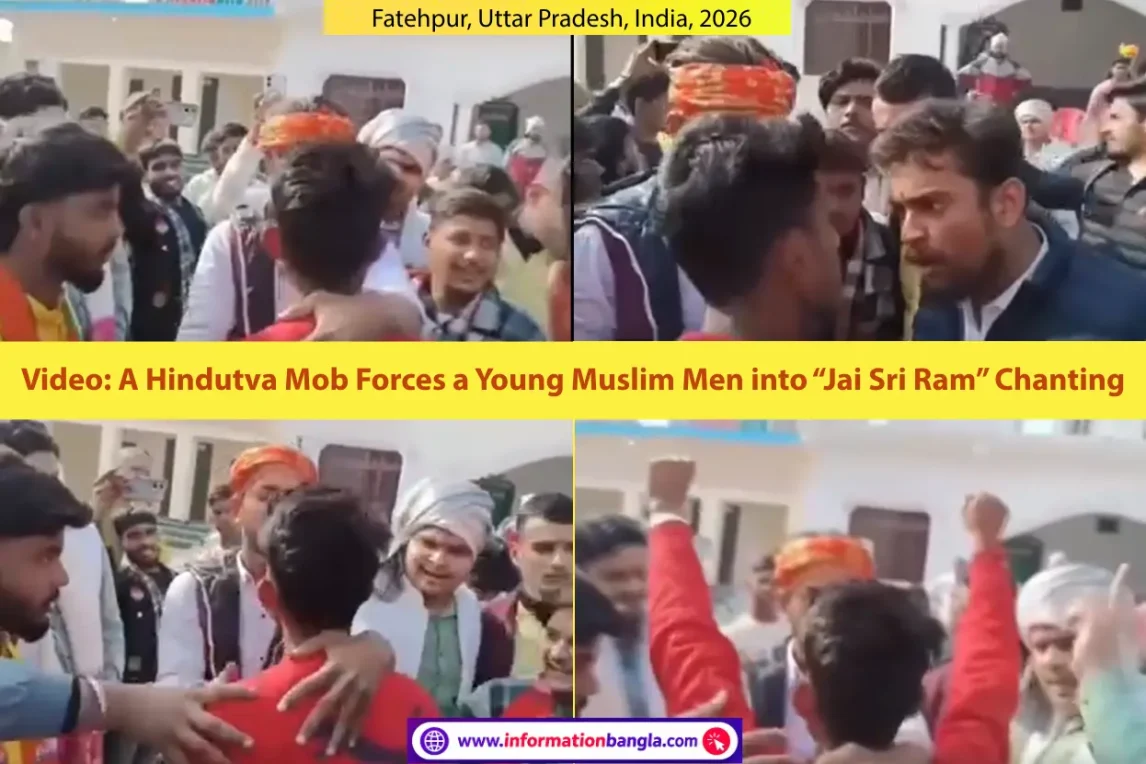
Forced To Chant ‘Jai Shri Ram’: Terrified Young Muslim Girl Cornered and Assaulted by Hindutva Mob in Brazen Display of Majoritarian Intimidation In Kolkata, India
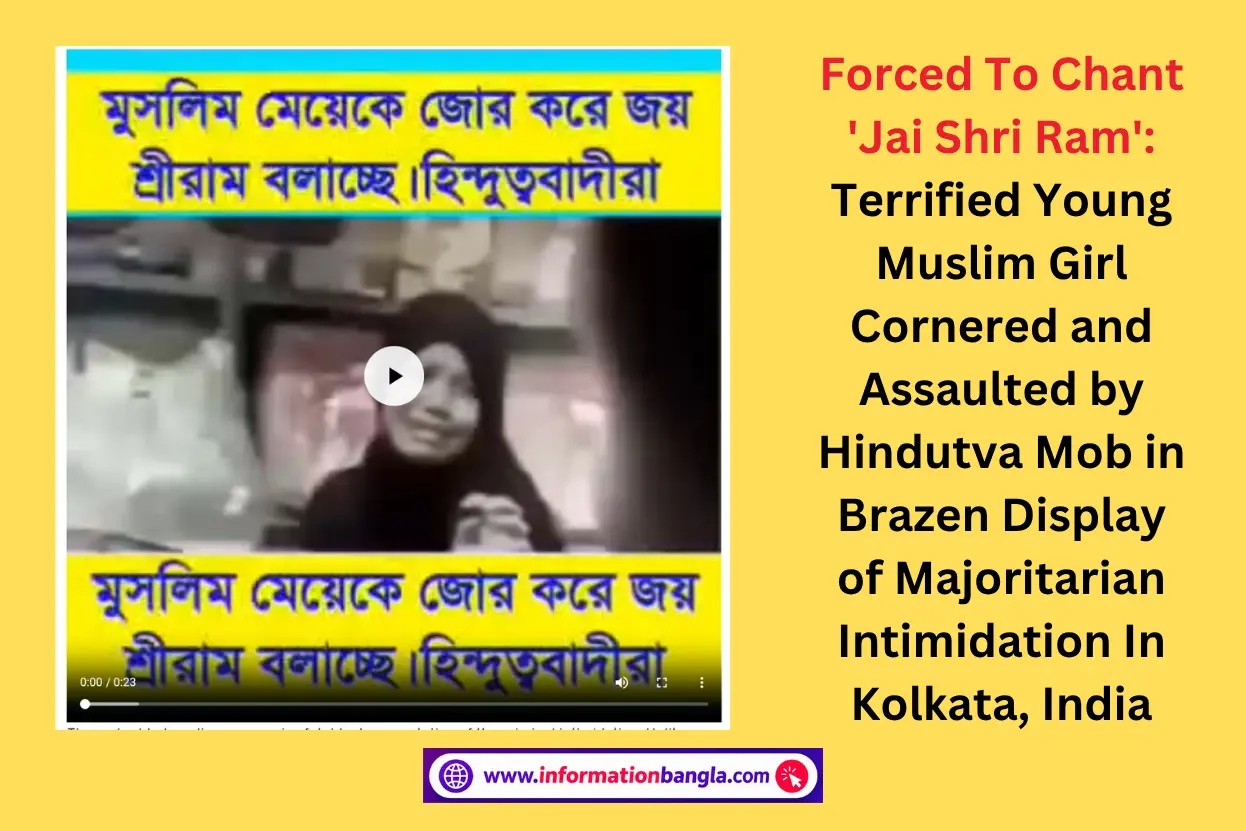
A deeply disturbing video capturing the raw terror of a young Muslim girl being surrounded, cornered, and violently coerced into chanting the religious-political slogan “Jai Shri Ram” by an aggressive group of men has sent shockwaves through civil society, laying bare the brutal ground reality of majoritarian intimidation In India. The incident, preserved in an unedited audio-visual recording that functions as definitive evidence of escalating street-level extremism, highlights a terrifying trend where sacred phrases are stripped of spiritual meaning and transformed into instruments of psychological and physical subjugation.
The visual and acoustic landscape of the recording provides an unvarnished window into the sheer vulnerability of religious minorities when trapped in the grip of a mob. Throughout the clip, a chorus of hostile, overlapping male voices can be heard barking demands at a visibly shaken, weeping young girl whose only pathway to temporary safety is complete compliance with her tormentors. The encounter encapsulates a profound moral and political crisis, demonstrating how vigilante elements operating under the banner of Hindutva ideology aggressively police public spaces and assert cultural dominance through raw coercion.
Video Footage of forced to Chant ‘Jai Shri Ram’ Assault
The embedded media serves as irrefutable documentation of the criminal intimidation. Unlike curated political rallies or sanitized statements issued by party spokespersons, this recording preserves the unedited, authentic acoustics of street-level persecution.
An exact transcription of the interaction reveals the precise mechanics of the coercion:
Mob Member 1 (Aggressive, pointing): “Jai Shri Ram!”
Mob Member 2 (Leaning in close): “Jai Shri Ram bol! (Say Jai Shri Ram!)”
Mob Member 1 (Loudly, shouting over her cries): “Jai Shri Ram bol!”
Young Girl (Weeping, trembling, voice barely audible): “Jai Shri Ram…”
Mob Member 3 (Triumphant, threatening): “Jai Shri Ram bolbi to, thik achhe? (You will say Jai Shri Ram, understood?)”
Mob Member 1 (Verifying compliance): “Jai Shri Ram koichhos to… (You have said Jai Shri Ram now…)”
The viral video highlights the ritualistic nature of the assault. The mob does not merely want the words spoken; they demand the total capitulation of the victim’s identity. The final, triumphant confirmations from the workload of aggressors underscore that the extraction of the slogan is viewed as a geopolitical victory over a defenseless individual. By recording the act and distributing it, the perpetrators seek to broadcast their dominance, using the girl’s terror and physical pain as a viral prop to inspire similar behavior across extremist networks.
A Community Cornered Through Fear
The documentation of the assault presents a textbook case of majoritarian bullying. The young girl, recognizable by her traditional attire, is completely cut off from escape routes by several adult males. The atmosphere is thick with implicit violence. There is no pre-existing provocation, no localized dispute, and no lawful pretext for the confrontation; the girl is targeted solely because of her visible religious identity.
As the men close in on her, their language shifts into a rhythmic, menacing interrogation. The objective is not conversation or ideological debate, but the systematic crushing of the victim’s dignity and agency. The young girl is seen visibly trembling, her breath hitching as tears stream down her face. She represents the ultimate asymmetry of power: an unarmed, solitary youth facing a group of aggressive, radicalized men who feel entirely empowered by the political climate to act as judge, jury, and executioner in the public square.
When the demand to chant is issued, her initial hesitation is met with sharper, louder commands. The psychological trauma inflicted in those few seconds is immense, sending a chilling signal not just to the immediate victim, but to the entire minority community regarding their conditional safety in shared public spaces.
The true horror of the footage escalates beyond verbal harassment into direct, physical subjugation. As the young girl stands weeping and frozen in terror, members of the surrounding mob begin striking her with their hands, physically shoving and beating her to break her resolve. Each physical blow is synchronized with a louder, more aggressive demand to chant the slogan. The visible distress of the victim increases exponentially as she is subjected to actual physical battery by adult men who face no immediate resistance.
This overt physical violence demonstrates that the objective of the majoritarian mob is not mere verbal compliance, but complete physical and psychological dominance. The use of open hands to strike a crying child underscores the complete absence of moral boundaries within the vigilante group, showing that their actions are fueled by a deep-seated ideological hatred that justifies physical harm against vulnerable individuals based entirely on their faith.
The Gendered Weaponization of Hindutva Ideology
To fully understand the gravity of this event, it must be analyzed through the lens of intersectional vulnerability. When Hindutva extremism targets a minority woman or a young girl, the violence is simultaneously communal and deeply patriarchal.
Historically, majoritarian conflicts have routinely targeted women as a means of inflicting maximum psychological humiliation upon the targeted community. By cornering a young girl in public, the mob signals that minority bodies are unprotected and subject to immediate, extrajudicial policing. Forcing her to utter the slogans of her oppressors while she is visibly weeping and being beaten is a deliberate exercise in degradation, designed to prove that her constitutional rights to freedom of conscience, religion, and personal security are entirely subservient to the whims of the dominant group.
Furthermore, this act represents a grotesque distortion of the religious phrase itself. “Jai Shri Ram,” which for generations existed as a devotional salutation rooted in the spiritual traditions of millions of Hindus, has been systematically weaponized by right-wing political formations over the past few decades. In the hands of a street mob, the phrase loses all spiritual sanctity and becomes an exclusionary war cry—a linguistic weapon used to mark territory, identify the “other,” and enforce a rigid hierarchical order.
State Complicity and the Institutional Ecosystem of Impunity
The proliferation of videos showing forced sloganeering and physical assault cannot happen in a vacuum. It is directly sustained by a political ecosystem that guarantees impunity for the perpetrators while systematically neglecting the protection of the victims.
In many similar instances across the region, the individuals who participate in these harassments do not bother to conceal their identities. They film themselves on high-definition smartphones and upload the footage to social media platforms with a sense of pride. This lack of fear points to a dangerous institutional decay. Vigilantes operate under the assumption that the state machinery—including local law enforcement and political patrons—will either look the other way or actively shield them from legal consequences.
When the state fails to act swiftly against those who terrify and beat children on the basis of their faith, it implicitly legitimizes the violence. Over the years, the blurring of lines between radical majoritarian organizations and state institutions has severely compromised the neutrality of the police. Minorities who approach law enforcement often face secondary victimization, counter-cases, or administrative inertia, leaving them entirely exposed to localized terror. This systemic failure hollows out the secular promises of the constitution, transforming equal citizenship into a hollow myth for millions of Indian Muslims.
The video evidence attached to this report is not an isolated misdemeanor; it is a symptom of a deep, malignant rot within the socio-political fabric of the nation. When a society reaches a point where adult men can gather to physically strike a young girl, leaving her weeping and shaking, and force her into religious submission without immediate, severe legal retribution, it surrenders its right to be called a civilized democracy.
This incident demands more than standard bureaucratic statements or temporary internet bans. It requires a systemic, uncompromising enforcement of the rule of law. The perpetrators captured in this video evidence must be identified, arrested, and prosecuted under stringent statutes against criminal intimidation, assault, hate crimes, and child harassment.
More broadly, it requires an urgent moral awakening from the majority community to reject the weaponization of their faith. True spiritual devotion cannot be extracted through physical battery or the tears of a frightened child. Until the state and civil society unite to dismantle the structures of hate that empower these mobs, the image of this young, terrified girl will stand as an undeniable indictment of an institutional system sliding rapidly toward majoritarian tyranny. For further contextual reporting on how tensions surrounding slogans manifest within local regional dynamics, view this broadcast on the Baruipur Sloganeering Clash Report. This video provides relevant background on the deep political unrest and communal frictions that escalate over forced public chants in West Bengal.
Sagar Soren is a Staff Reporter for InformationBangla.com, specializing in ground-level investigative journalism and human rights. He is committed to delivering accurate, unbiased, and fact-based news.