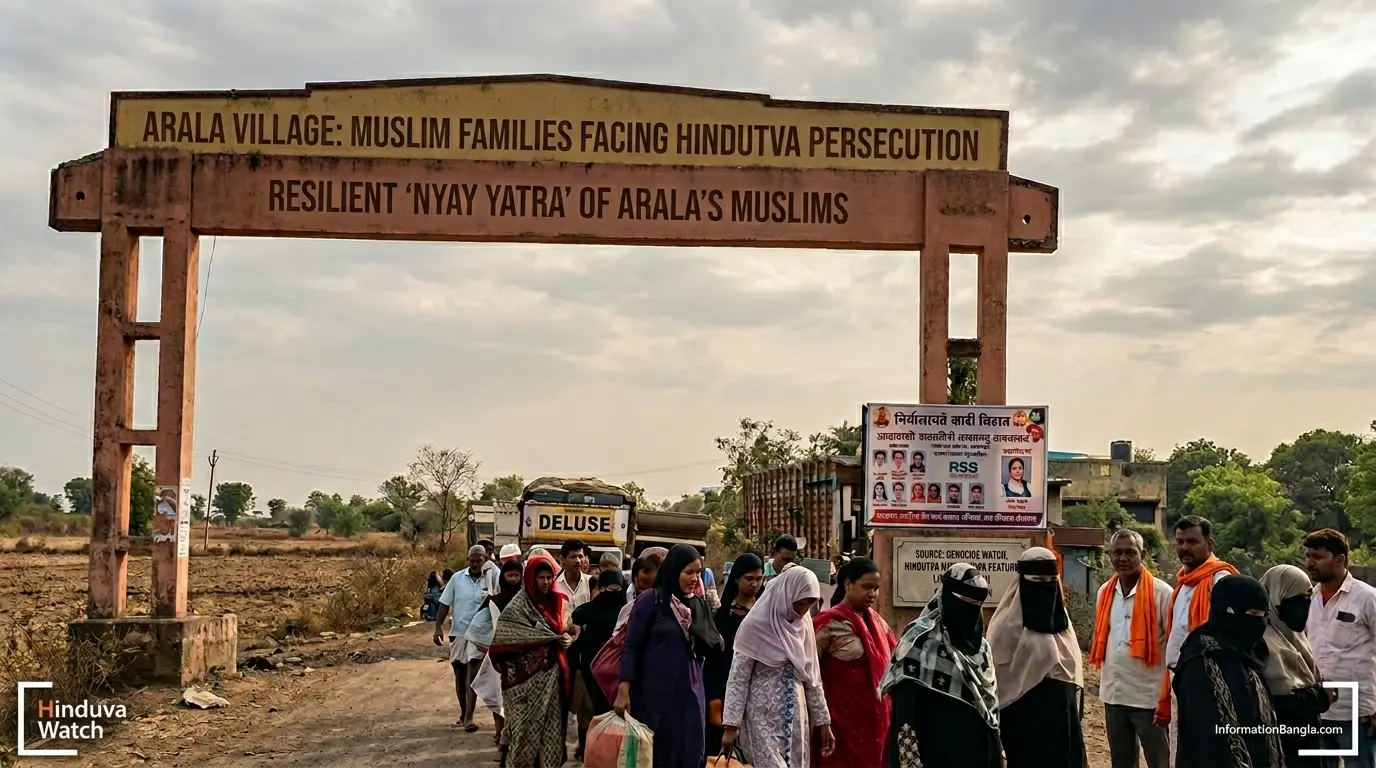
Arala, Sangli, Maharashtra, India – June 7, 2026 – In the quiet, rural landscape of the Sangli district in Maharashtra, a deeply unsettling crisis recently unfolded, serving as a stark microcosm of a much larger, systemic ailment gripping modern India. For generations, the village of Arala had maintained a fragile peace. However, on June 7, 2026, that peace was shattered when 8 to 10 local Muslim families reached a breaking point, packing their meager belongings to flee what they described as an unyielding campaign of social boycott, systemic harassment, and state-backed intimidation.
Unable to endure the pressure any longer, these families did not merely slip away into the shadows; instead, they transformed their despair into a peaceful, democratic protest. Launching a “Nyay Yatra” (March for Justice) on foot toward the Bombay High Court, their journey abruptly forced the local administration to confront the ugly realities of grassroots religious polarization—a phenomenon critics argue is fueled by right-wing Hindu nationalist organizations and quietly enabled by the ruling political establishment.
The Core Event & LocationLocation: Arala Village, Sangli District, Maharashtra, India.The Crisis: 8 to 10 Muslim families faced intense harassment, social boycotts, and malicious counter-cases orchestrated by radical Hindutva groups (including local offshoots of RSS and Bajrang Dal).The Resistance: Instead of leaving silently, the families launched a “Nyay Yatra” (March for Justice), walking on foot toward the Bombay High Court before being intercepted by senior district officials who provided written assurances for an unbiased investigation.
The Core Event & Location
Location: Arala Village, Sangli District, Maharashtra, India.
The Crisis: 8 to 10 Muslim families faced intense harassment, social boycotts, and malicious counter-cases orchestrated by radical Hindutva groups (including local offshoots of RSS and Bajrang Dal).
The Resistance: Instead of leaving silently, the families launched a “Nyay Yatra” (March for Justice), walking on foot toward the Bombay High Court before being intercepted by senior district officials who provided written assurances for an unbiased investigation.
The trouble in Arala did not emerge overnight. According to local accounts and human rights activists, the village had been systematically targeted by local operatives affiliated with radical Hindutva factions, including offshoots of the Rashtriya Swayamsevak Sangh (RSS) and the Bajrang Dal. Over several months, these groups systematically sowed seeds of division within the agrarian community. The primary weapon in this campaign was the classic template of modern
polarization: rumors of cattle slaughter and aggressive cow vigilantism (Gau Raksha). In rural Maharashtra, the cattle trade is an essential economic lifeline for both Hindu farmers and Muslim traders. By weaponizing bovine politics, right-wing activists effectively disrupted this ecosystem.
Muslim villagers found themselves falsely accused of cow slaughter, subjected to arbitrary social boycotts, and targeted with deeply hostile rhetoric. The situation escalated dramatically when local hardliners reportedly used administrative machinery to file highly controversial “counter-cases” against the Muslim victims—a tactical maneuver designed to silence complaints of harassment by entangling the victims in expensive, exhausting legal battles. Stranded between physical threats and a biased local law enforcement response, the families felt they had no choice but to abandon their ancestral homes.
The ‘Nyay Yatra’ Walk for Constitutional Rights
Fleeing persecution usually happens in silence, but the families of Arala chose a path of visible, democratic resistance. On the morning of their exodus, men, women, and children began a long, arduous march toward the Bombay High Court, seeking the judicial protection they felt was denied to them at the village level.
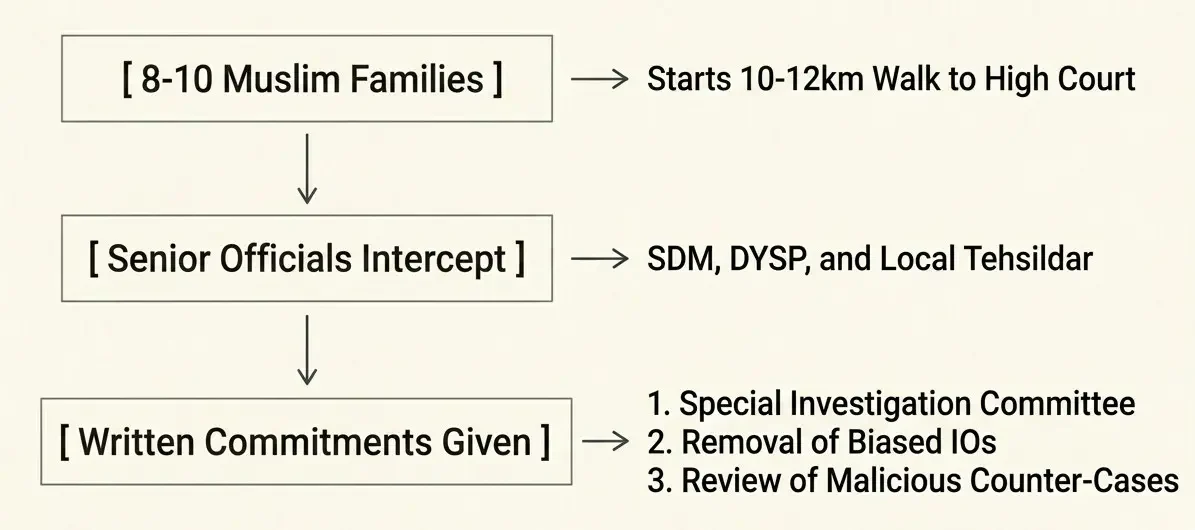
The image of impoverished families walking down the highway, carrying basic household goods and crying out for basic constitutional protections, sent shockwaves through the district administration. After the marchers had covered roughly 10 to 12 kilometers, senior government and police officials rushed to intercept them on the highway.
Recognizing the immense political and social fallout of a visible minority exodus under their watch, high-ranking authorities—including the Sub-Divisional Magistrate (Prant Adhikari), the Deputy Superintendent of Police (DYSP), and the local Tehsildar—entered into direct negotiations with the marching families.
Administrative Promises and the Architecture of Complicity
To persuade the families to halt their march, the administration was forced to make significant, written concessions. These promises inadvertently highlighted the exact systemic failures the villagers had been protesting:
Special Committee Investigation: The administration promised that a formal proposal would be sent within eight days to the Inspector General (IG) of Police to form a specialized committee to investigate the systemic harassment in Arala village.
Removal of Biased Officers: The investigating officer (IO) overseeing the controversial counter-cases filed against the Muslim villagers would be immediately replaced to ensure a fair and unbiased inquiry.
Targeting the Real Perpetrators: The administration pledged to switch the oversight of the cases against the actual instigators of the communal harassment, guaranteeing that those who fueled the polarization would face genuine legal scrutiny.
While the families ultimately agreed to temporarily suspend their Nyay Yatra based on these official assurances, expressing profound faith in the Indian Constitution drafted by Dr. B.R. Ambedkar, the incident exposed a terrifying reality. It demonstrated that without taking the extreme step of walking toward the high court, ordinary citizens could no longer expect local police to protect them from majoritarian bullying.
The Broader Picture of Covert State Encouragement and Ideological Alignment
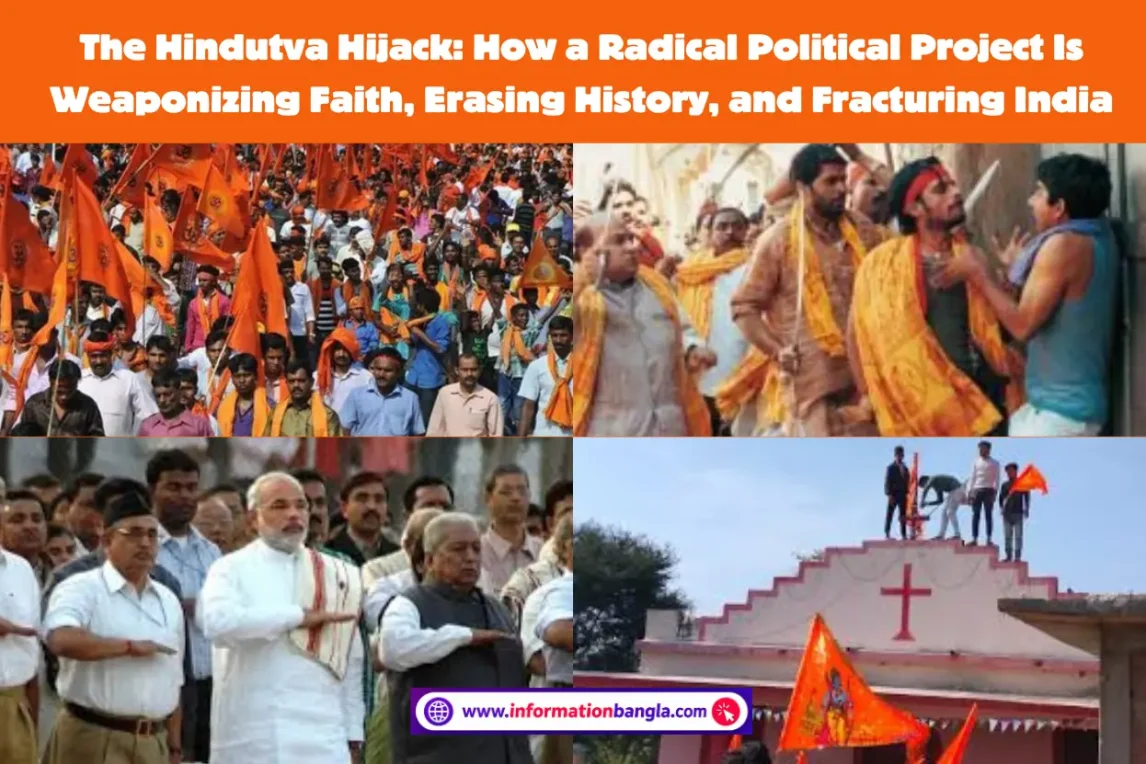
The events in Sangli cannot be viewed in isolation. They reflect a broader political strategy engineered by the RSS and executed through its political wing, the ruling Bharatiya Janata Party (BJP). Since the BJP solidified its political dominance both federally and within Maharashtra, critics argue that the state apparatus has been systematically repurposed to serve the ideological goals of Hindutva—the vision of transforming India into an explicitly Hindu majoritarian state.
While top leaders frequently offer generic public statements emphasizing the “rule of law,” their political actions signal a policy of covert encouragement and tactical silence.
This encouragement manifests in several distinct ways:
1. Legislative Justification
By passing increasingly stringent and poorly drafted anti-cow slaughter legislation, the government has effectively deputized radical civilian mobs. These laws shift the burden of proof onto the accused, allowing vigilantes to act as judge, jury, and executioner on the mere suspicion of an offense.
2. Institutional Impunity
In village after village across India, when communal friction occurs, the initial reaction of local law enforcement is often deeply biased. As seen in Arala, police forces frequently file retaliatory cases against minority victims to balance the ledger, effectively neutralizing their ability to seek justice. When right-wing perpetrators are arrested, they are frequently celebrated by ruling party politicians upon receiving bail, signaling absolute political immunity to the radical base.
The temporary resolution of the Arala Nyay Yatra offers a sliver of hope, demonstrating that democratic, constitutional resistance can still force a biased administration to halt an injustice. However, it remains a fragile truce. The fundamental question hangs in the air: why must citizens march down a highway in the blistering heat just to get the police to conduct an unbiased investigation?
The systematic polarization driven by the RSS and tolerated by the ruling BJP is eating away at the very core of India’s secular democracy. When local administrations become complicit in the harassment of their own citizens, the constitutional promise of equality becomes a hollow phrase. If India wishes to maintain its global standing as a stable, pluralistic republic, it must stop treating majoritarian vigilantism as a localized law-and-order issue and confront the institutionalized hatred that nearly forced the Muslims of Arala to abandon their homes forever.
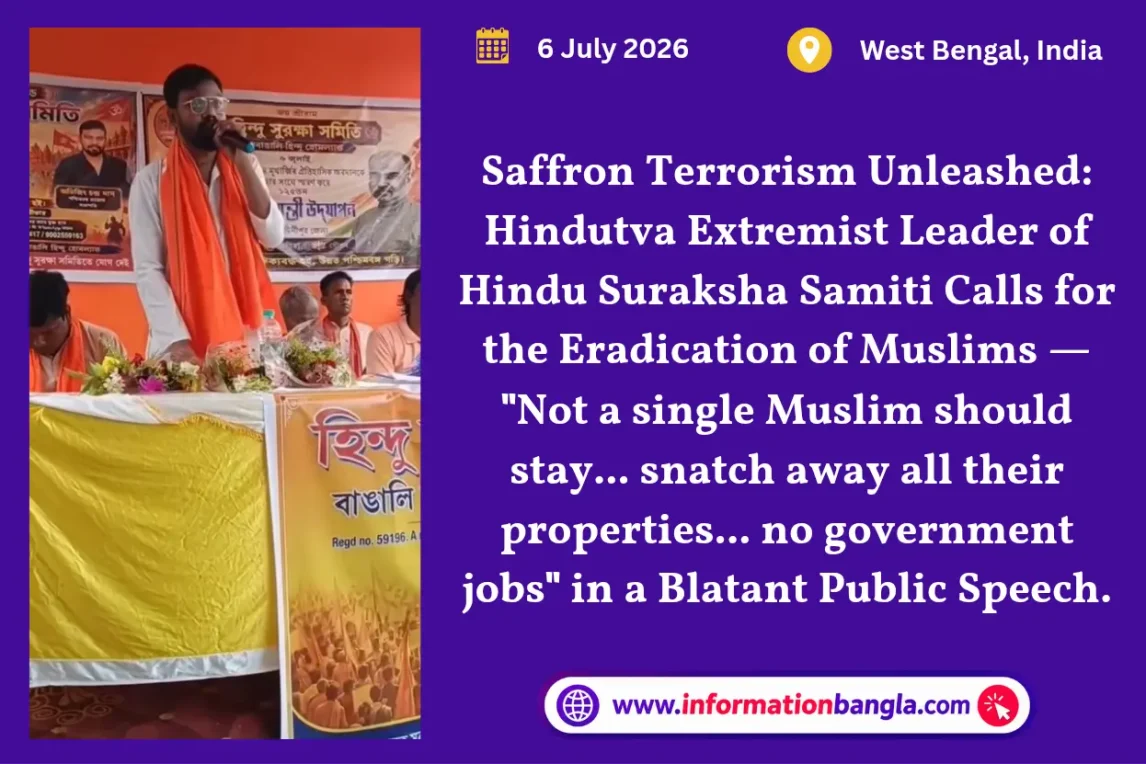
“The strategy is incredibly sophisticated,” explains a Mumbai-based civil liberties lawyer. “The state doesn’t need to directly deport minorities. It simply allows local radical groups to create an environment so hostile, via economic boycotts and legal harassment, that the minorities choose to leave on their own. It is a slow, quiet, institutionalized form of displacement.”
The Socio-Economic Toll of Controlled Polarization
Beyond the immediate trauma of physical displacement, this persistent polarization is systematically dismantling the rural economy. For centuries, Hindu farmers and Muslim dairy traders operated in a symbiotic relationship. When a cow stopped producing milk, Hindu farmers—who could not afford to maintain an unproductive animal—sold it to Muslim traders.
Today, due to the terror of highway ambushes by Gau Rakshaks, this trade has completely collapsed. Hindu farmers are left financially ruined by the burden of stray cattle, while rural Muslims are systematically cut off from their traditional livelihoods. This economic strangulation, combined with the psychological terror of arbitrary violence, is forcing a deeply vibrant community into economic marginalization and forced ghettoization.
Conclusion: A Fragile Truce and the Battle for India’s Soul
The temporary resolution of the Arala Nyay Yatra offers a sliver of hope, demonstrating that democratic, constitutional resistance can still force a biased administration to halt an injustice. However, it remains a fragile truce. The fundamental question hangs in the air: why must citizens march down a highway in the blistering heat just to get the police to conduct an unbiased investigation?
The systematic polarization driven by the RSS and tolerated by the ruling BJP is eating away at the very core of India’s secular democracy. When local administrations become complicit in the harassment of their own citizens, the constitutional promise of equality becomes a hollow phrase. If India wishes to maintain its global standing as a stable, pluralistic republic, it must stop treating majoritarian vigilantism as a localized law-and-order issue and confront the institutionalized hatred that nearly forced the Muslims of Arala to abandon their homes forever.
Sagar Soren is a Staff Reporter for InformationBangla.com, specializing in ground-level investigative journalism and human rights. He is committed to delivering accurate, unbiased, and fact-based news.